
TL;DR:
Apparel ERP is business software built for garment and footwear makers. It connects orders, BOMs, purchasing, stores, production, quality, dispatch and accounts, and it understands style, colour and size in a way generic ERP does not.
Three weeks before Diwali, the owner of a knitwear unit in Tiruppur asks a simple question on the morning call. “How much 30s combed cotton yarn do we have?”
The stores in-charge says 4.2 tonnes, going by the register. Accounts says 3.6 tonnes, going by Tally. The knitting supervisor says there’s about two tonnes on the floor and some lying at the knitter’s place, and he’ll check.
Three answers to one question. The owner decides to buy more yarn to be safe. Two months later, 1.5 tonnes of surplus yarn sits in the godown with cash locked in it.
That gap between three versions of stock is exactly where apparel ERP earns its place.
What is apparel ERP?
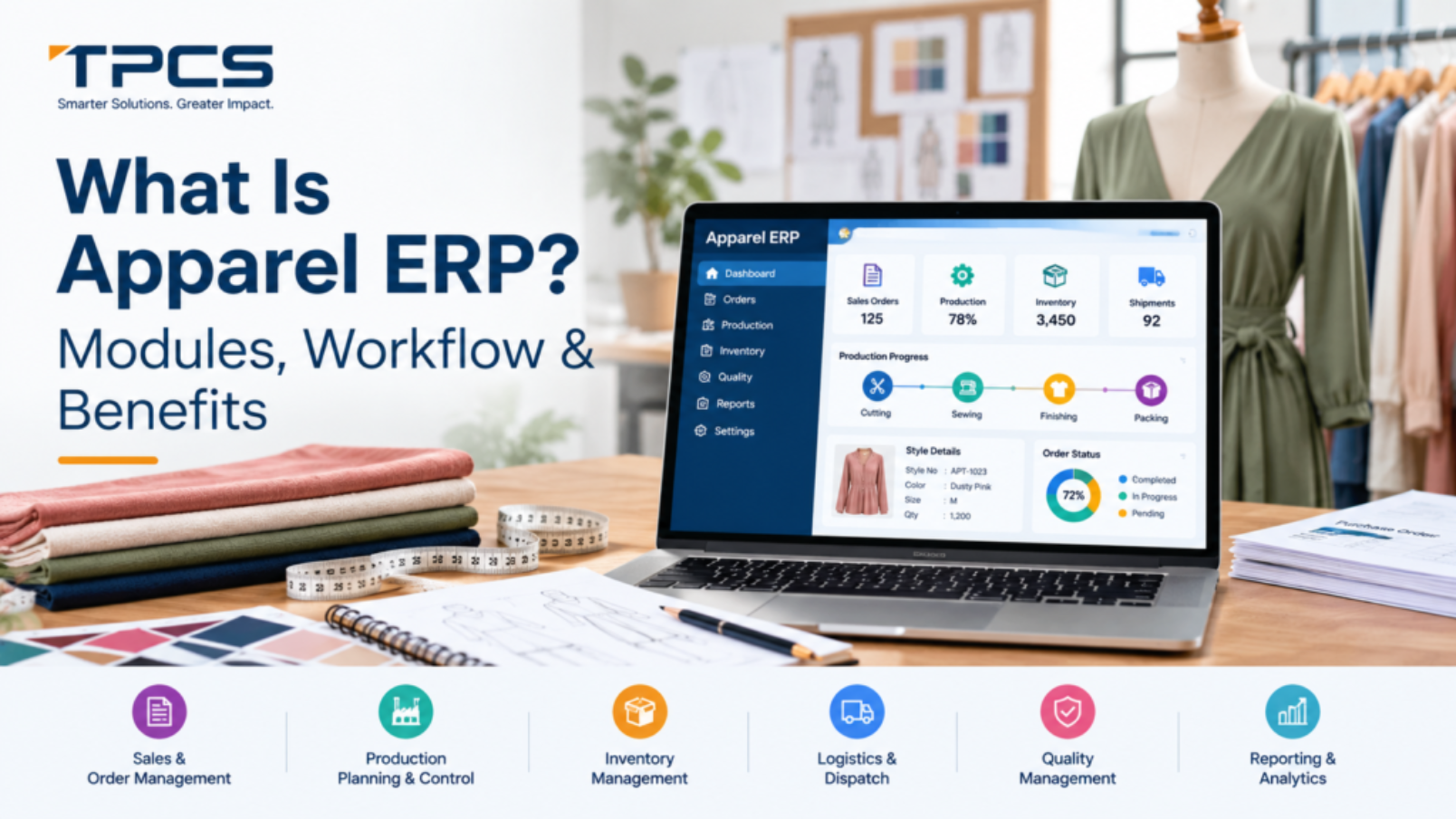
Definition: Apparel ERP (enterprise resource planning) is software that runs a garment, textile or footwear business on one shared database, from the buyer’s order to purchase, production, quality, dispatch and accounts. Unlike general ERP, it is built around the style, colour and size structure that every garment order has.
In plain terms, if your sales order, BOM, stores register, cutting plan and invoice all live in one system, a question like “how much yarn do we have” has one answer.
What makes apparel ERP different from generic ERP
A generic ERP sees a product as one item code with one quantity. A garment order rarely works that way.
One buyer PO for a polo shirt can have four colours and six sizes. That’s 24 separate quantities, each with its own fabric consumption, its own trims and sometimes its own label. Generic ERP forces you to create 24 item codes and track them by hand. Apparel ERP handles the style-colour-size matrix natively.
There are other industry details that generic tools miss:
- Fabric consumption changes by size, so the BOM must explode by size ratio, not just by order quantity.
- Job work is normal in India. Fabric goes out for dyeing, printing or compacting and comes back with process loss. Apparel ERP tracks what is lying at each job worker.
- Wastage happens at every stage, from knitting loss to cutting end-bits to rejections. A garment system expects and records it.
- Buyers want shipment-wise and PO-wise traceability, with packing lists by carton, colour and size.
Core modules of an apparel ERP
Not every business needs every module on day one. This table shows what each one does and the question it answers.
| Module | What it handles | The question it answers |
| Order management | Buyer POs, style-colour-size breakdown, delivery dates | What did we promise, to whom, by when? |
| BOM and MRP | Material requirement from BOM and order quantity | What do we need to buy for this order? |
| Purchase | Supplier POs, approvals, rates, follow-ups | What has been ordered and what’s pending? |
| Stores and inventory | GRN, issues, roll and lot tracking, stock by location | What do we have, and where? |
| Job work | Outward challans, inward receipts, process loss | What is lying at which job worker? |
| Production | Cutting, sewing, finishing, WIP by line | Where is each order on the floor? |
| Quality | Inline checks, AQL final inspection | Is this lot good enough to ship? |
| Dispatch and invoicing | Packing lists, invoices, e-invoice and e-way bill | What shipped, and is it billed? |
| Finance and costing | Actual vs planned cost, margins, payables | Did this order make money? |
If you want to see how the production module works on the floor, read our post on shopfloor and WIP tracking for garment factories.
How apparel ERP works: one order, start to finish
Follow a single order for 12,000 polo shirts through an apparel ERP and you can see why the shared database matters.
The buyer PO comes in and the merchandiser enters it with the colour and size breakdown. The approved BOM, usually from PLM, is attached to the style.
MRP explodes the BOM against the order: so many kilos of pique fabric by colour, so many collars and cuffs, buttons, labels, polybags and cartons. It checks what’s already in stock and suggests what to buy.
Purchase raises POs to yarn suppliers, knitters and trim suppliers. When material arrives, stores records the GRN against the PO, roll by roll for fabric.
Fabric goes out for dyeing on a job work challan. The system knows 2,400 kg went out and expects it back, less an agreed process loss.
Cutting gets a cut plan by colour and size. Sewing lines report output by operation or bundle. Quality records inline defects and the final AQL inspection.
Finishing packs cartons as per the buyer’s ratio. Dispatch generates the packing list, invoice and e-way bill. Finance sees actual fabric used, actual labour and actual overheads against the costing done at quote stage.
At any point, the owner can open the order and see exactly where it stands. No calls, no three versions.
Visual suggestion: Order-to-dispatch flow diagram with each module labelled along the path, ending at “order profitability”.
Apparel ERP vs Tally vs spreadsheets
Many Indian garment units run on a mix of Tally for accounts and Excel for everything else. That works until the order book grows.
| What you need | Spreadsheets | Tally alone | Apparel ERP |
| Style-colour-size orders | Manual, error-prone | Not designed for it | Built in |
| BOM and material planning | Manual formulas | Not available | Automatic from BOM |
| Job work tracking | Separate register | Limited | Lot and process-wise |
| WIP on the floor | Supervisor’s notebook | Not available | Live by line and order |
| GST and accounts | Not suitable | Strong | Built in or integrated |
Tally is excellent at accounting, and plenty of garment manufacturers keep it. The usual set-up is apparel ERP for operations, connected to Tally or SAP for books. We explain how that works in our post on the apparel add-on for SAP and Tally.
When does a garment business need apparel ERP?
Turnover alone isn’t the trigger. Complexity is. These are the signals we see most often:
- You handle more than two or three buyers, each with different packing, labelling and inspection rules.
- Stock figures disagree between stores, accounts and production, like the Tiruppur yarn story above.
- Material is regularly lying at job workers and nobody has a clean pending list.
- You only find out an order made a loss after it has shipped.
- Your best merchandiser is your system. When she’s on leave, things slow down.
A 50-machine unit with one buyer can often manage without ERP. A 300-machine unit with six buyers and outsourced processing usually cannot.
How much does apparel ERP cost, and how long does it take?
Cost depends on the number of users, modules, and whether you choose cloud or on-premise. We have broken this down separately in our apparel ERP pricing guide.
On timelines, a phased approach works best. Start with orders, purchase and stores, then add production and quality. Our 180-day guide to implementing ERP in apparel and footwear lays out each phase.
One opinion from experience: the software is rarely the reason an ERP project fails. Unclear item masters and half-hearted data entry on the floor are. Fix those, and most systems work.
Editor note (remove before publishing): Add one real, attributable observation from a TPCS rollout (for example, the first report the owner started using daily).
How to pick the right apparel ERP
Ask vendors to demo your own order, not their sample data. Give them a real style with colours, sizes, a job work process and a buyer packing ratio. Watch how many workarounds they need.
Check whether the system handles Indian realities: GST e-invoicing, e-way bills, job work challans and ITC-04 data. Our post on GST-compliant manufacturing ERP covers what to check.
Then shortlist. Our guide to the best apparel ERP for manufacturers compares options.
Frequently asked questions
What is apparel ERP used for?
It runs the garment business on one system: buyer orders, BOM-based material planning, purchasing, stores, job work, production tracking, quality, dispatch and accounts.
Is apparel ERP different from garment ERP?
They usually mean the same thing. Both refer to ERP built for clothing manufacturing, with style, colour and size handling, BOMs and production tracking.
Can small garment manufacturers use ERP?
Yes, if they handle multiple buyers, outsourced processes or frequent style changes. A very small unit with one buyer and simple products may manage with Tally and good registers for a while.
Does apparel ERP replace Tally?
Not always. Many manufacturers keep Tally for accounts and use apparel ERP for operations, with the two connected so entries don’t have to be typed twice.
What is the difference between apparel ERP and PLM?
PLM manages product development until a style is approved. Apparel ERP takes over from the confirmed order through production, dispatch and billing.
Facebok: https://accountscenter.facebook.com/?entry_point=app_settings