
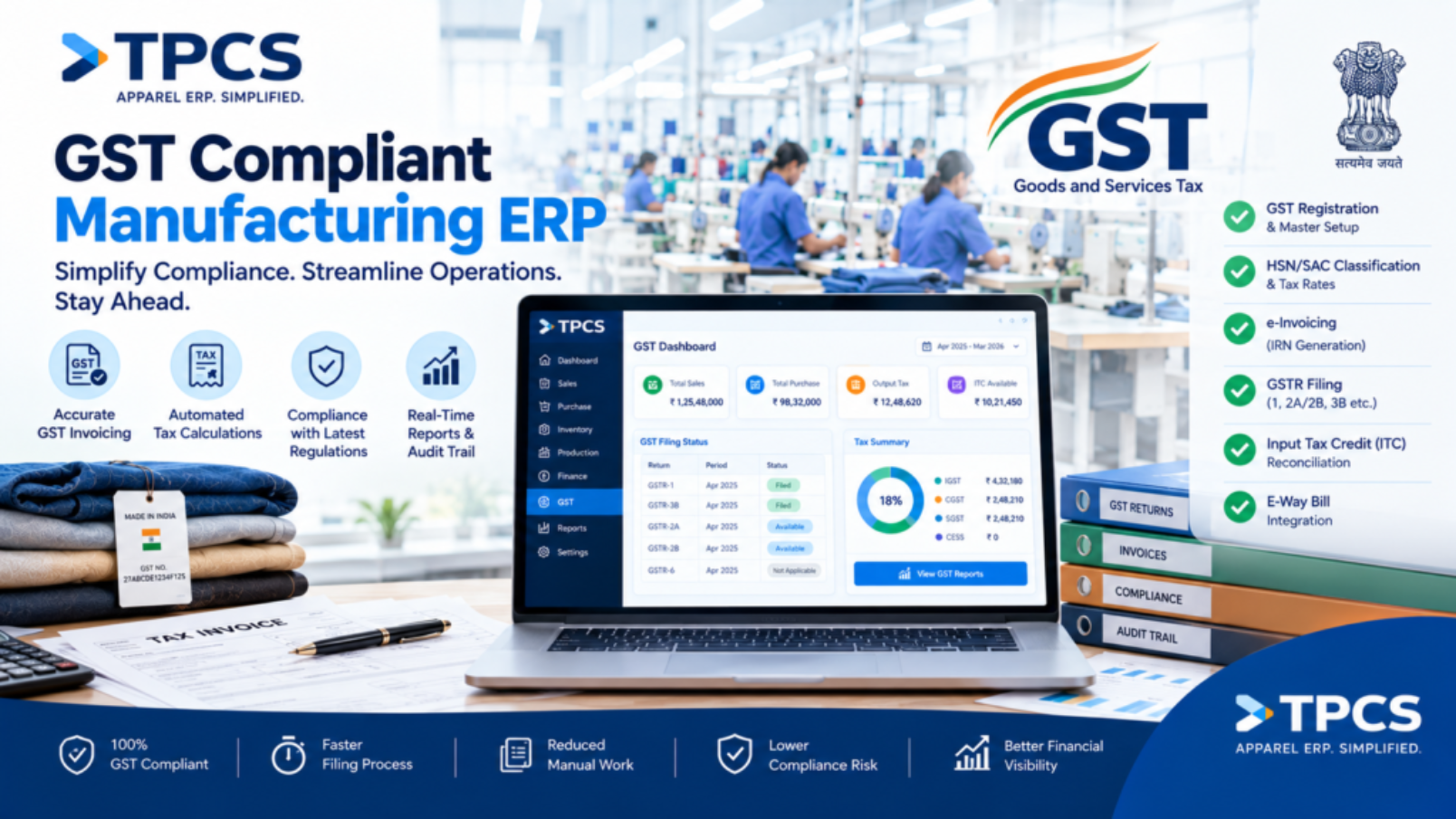
TL;DR:
A GST compliant manufacturing ERP generates GST-correct invoices, reports e-invoices to the IRP within the allowed time, creates e-way bills, tracks job work for ITC-04, and keeps purchase data ready for GSTR-2B matching. For apparel and textile units, job work and price-based tax rates make this harder than in most industries.
On the 9th of every month, the accounts team at a woollen garment unit in Ludhiana goes quiet. GSTR-1 is due on the 11th.
Sales invoices come from one system, e-way bills were made by hand on the portal, job work challans are in a book in the stores, and the purchase register needs matching against GSTR-2B to see which supplier credit is actually available. Two people work late for three days.
None of this is unusual. It’s what happens when operations and GST live in different places.
What is a GST compliant manufacturing ERP?
Definition: A GST compliant manufacturing ERP is business software that records purchases, production, job work, sales and dispatch in a way that produces correct GST documents and return data automatically. It handles tax calculation, e-invoicing, e-way bills, job work reporting and input tax credit reconciliation without re-entering data from operations.
The key word is “automatically.” Almost any accounting tool can print a GST invoice. A compliant manufacturing ERP makes the tax data a by-product of normal work.
The GST rules a manufacturer’s ERP must handle in 2026
This is a practical summary as of October 2026, not legal advice. GST rules change through notifications and advisories, so check with your CA before acting.
E-invoicing
E-invoicing applies to GST-registered businesses whose aggregate annual turnover (AATO) has exceeded ₹5 crore in any financial year since 2017-18. That threshold has applied since 1 August 2023 under CBIC Notification 10/2023. Once you cross it, you stay in, even if turnover later drops.
The 30-day IRP reporting limit
Since 1 April 2025, businesses with AATO of ₹10 crore or more must report invoices to the Invoice Registration Portal within 30 days of the invoice date. The portal rejects older documents. Units between ₹5 crore and ₹10 crore must still e-invoice, but the hard 30-day block doesn’t apply to them yet.
For a factory that sometimes raises invoices late or in batches, this is a real risk. Your ERP should generate the IRN at the time of invoicing, not at month-end.
E-way bills
Goods movements above the e-way bill threshold (generally ₹50,000 consignment value, with some state variations) need an e-way bill. In apparel, that includes not just sales but also job work movements, which many units forget.
Job work and ITC-04
Goods sent to job workers move under a challan and must come back within one year for inputs (three years for most capital goods) to avoid being treated as a supply. The principal reports these movements in ITC-04: half-yearly if AATO is above ₹5 crore, annually otherwise. Our post on jobwork tracking software covers this in detail.
Input tax credit and GSTR-2B
Credit is only safe when the supplier has reported the invoice and it appears in your GSTR-2B. The ERP needs your purchase data in a form that can be matched against 2B every month.
HSN and rates
Garments, fabrics, yarns and footwear fall under different HSN chapters, and some apparel and footwear rates depend on the sale value per piece. The ERP must pick the right rate per line, not per invoice.
Editor note (remove before publishing): CA reviewer to confirm current apparel and footwear rate slabs and add them here, with the notification reference.
Why apparel and textiles are harder than most industries
Three things make GST tougher for garment and textile units than for, say, a machine shop.
Job work volume. Material goes in and out several times per order, across many job workers. Every movement needs a challan and feeds ITC-04.
Value-based rates. When the rate depends on price per piece, a single invoice can carry different rates for different styles or sizes.
Seasonal peaks. Invoices pile up before Diwali, Christmas shipments or the end of a buyer’s season. That’s exactly when a 30-day reporting window is easiest to miss.
GST compliance checklist for a manufacturing ERP
Use this table in vendor demos. Ask them to show each item live, on your own sample data.
| Requirement | What to check in the demo |
| GST invoice generation | Correct tax type (CGST/SGST or IGST) by place of supply, HSN per line |
| Value-based rate selection | Rate picked per line based on sale value, not typed manually |
| E-invoicing | IRN and QR code generated from the invoice screen via IRP integration |
| 30-day limit control | Alerts or blocks for invoices not yet reported, sorted by age |
| E-way bills | Generated from sales and job work challans, with vehicle updates |
| Job work challans | Outward and inward tracking with balance and ageing |
| ITC-04 data | Report or export structured to the ITC-04 format |
| GSTR-1 data | Outward supply data ready for filing without re-entry |
| GSTR-2B reconciliation | Purchase register matched to 2B with mismatch report |
| Credit and debit notes | Linked to original invoices and reported correctly |
| Accounts integration | Clean posting to Tally, SAP or the ERP’s own finance module |
| Audit trail | Who changed what, and when, on every tax document |
Visual suggestion: The checklist above as a printable one-page PDF for buyers to take into vendor demos.
ERP and Tally: replace or connect?
A lot of Indian manufacturers ask whether they need to leave Tally to be GST compliant. Usually, no.
Tally handles GST returns well. The gap is upstream: job work, production and dispatch data that never reaches Tally properly, or reaches it by re-typing. A common and sensible set-up is an apparel ERP for operations, generating invoices, e-way bills and challans, connected to Tally for books and returns.
We explain how this works in our post on the apparel add-on for SAP and Tally.
Mistakes we see in GST set-ups at manufacturing units
- Treating job work challans as a stores formality, then rebuilding ITC-04 data at filing time.
- Generating e-invoices in a batch at month-end, which becomes risky once AATO crosses ₹10 crore.
- Hard-coding one GST rate per item when the rate depends on sale value.
- Matching purchase credit against the supplier’s invoice copy instead of GSTR-2B.
- Allowing invoice edits after IRN generation without a proper credit note.
Editor note (remove before publishing): Add one real, anonymised example from a TPCS rollout, for example days saved at month-end closing after GST data moved into the ERP.
Where TPCS fits
TPCS is built for apparel, textile and footwear manufacturers, with job work, dispatch and invoicing handled on the same platform as production, and integration to SAP and Tally for accounts. For the wider ERP picture, read what is apparel ERP.
Frequently asked questions
What is a GST compliant ERP?
It is ERP software that produces correct GST invoices, e-invoices, e-way bills, job work records and return data automatically from day-to-day transactions.
Is e-invoicing mandatory for manufacturers in 2026?
Yes, if your aggregate annual turnover has exceeded ₹5 crore in any financial year since 2017-18. That threshold has applied since 1 August 2023.
What is the 30-day rule for e-invoices?
Businesses with AATO of ₹10 crore or more must report invoices to the IRP within 30 days of the invoice date. The portal rejects documents reported later. This has applied since 1 April 2025.
Does a garment manufacturer need to file ITC-04?
Yes, if it sends goods to job workers. ITC-04 is filed half-yearly when AATO is above ₹5 crore and annually otherwise.
Can I stay on Tally and still use a manufacturing ERP?
Yes. Many manufacturers keep Tally for accounts and returns and use an ERP for operations, with the two connected.
Make GST a by-product, not a month-end project
Bring one month’s sales, job work and purchase data to a TPCS demo. We’ll show which GST documents and reports would come out of it without re-typing.