
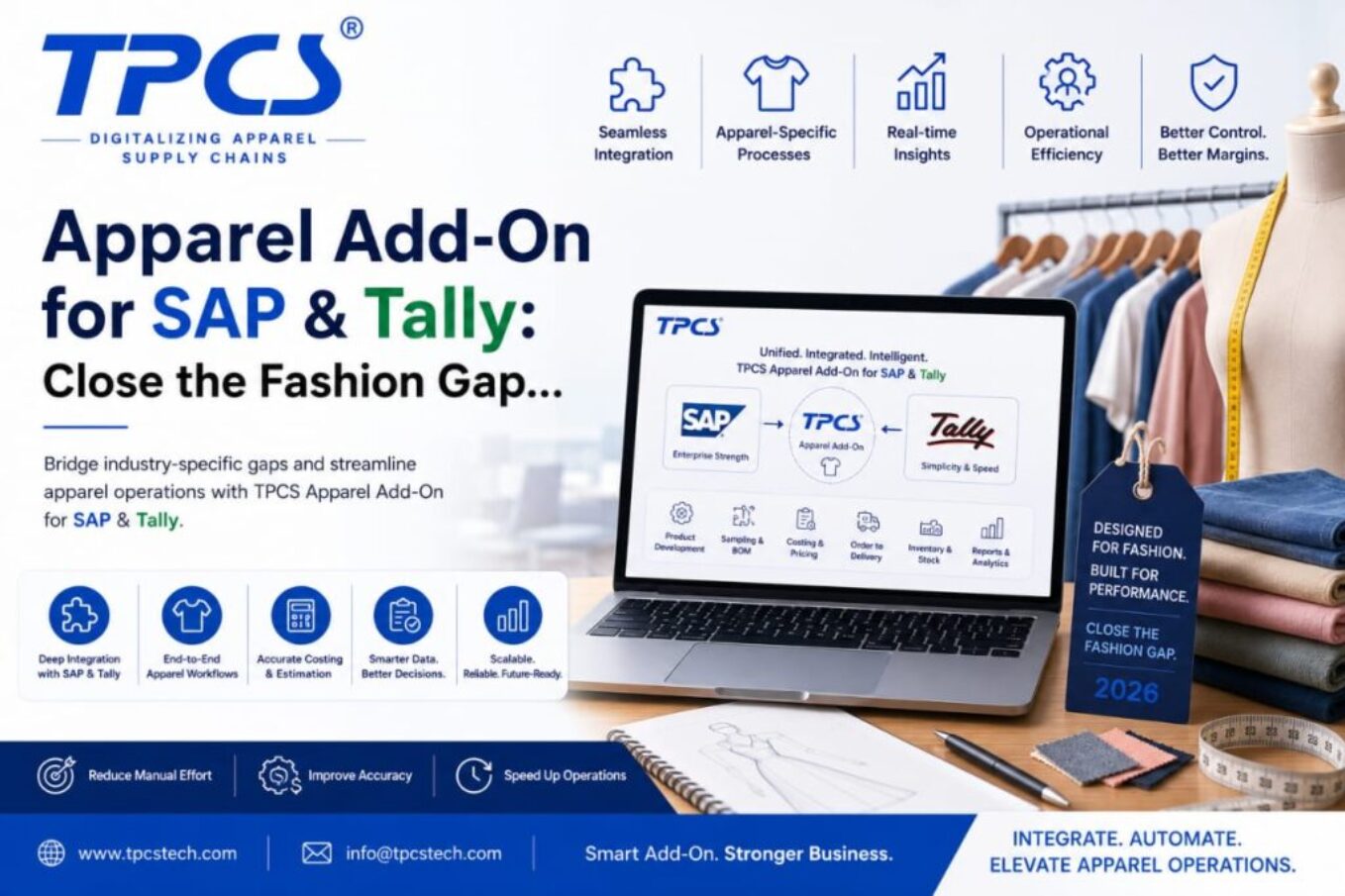
Why generic ERPs don’t handle style, size and colour natively
An apparel add-on for SAP and Tally adds fashion-specific capabilities to your existing ERP. It manages styles, sizes, colourways, BOMs and production data without forcing manufacturers to replace their core accounting system.
SAP, Dynamics 365, NetSuite and Tally were all built around the idea that a product is a single SKU — and a garment isn’t one.

A style is one design expressed across multiple colourways and a size curve, each combination consuming a slightly different quantity of fabric and trim, built from a bill of materials with its own lead time.
Force-fitting that into a generic ERP’s flat item master means either creating a separate SKU for every size-colour combination or falling back to spreadsheets for anything fashion-specific — exactly the pattern that shows up across manufacturing today.
Every manufacturer in Kaufman Rossin’s 2026 mid-market research runs on an ERP, and legacy integration is still the top barrier to modernising it, cited by 55% of manufacturers against a 41% average across the broader mid-market.
KEY TAKEAWAYS (TL;DR)
● Legacy ERP integration is the single biggest barrier manufacturers cite when trying to modernise operations — named by 55% of manufacturers versus a 41% average across the broader mid-market.
● Every manufacturer in Kaufman Rossin’s 2026 survey runs on an ERP, yet only 27% have a data warehouse or data lake, versus 60% across the broader mid-market — a structural gap that shows up hardest in fashion, where SAP and Tally have no native concept of a size curve or colourway.
● 94% of mid-market companies now use generative AI, but only 2% have operationalised it — the gap between adoption and real deployment is almost entirely a data and integration problem, not a tooling problem.
● A rip-and-replace ERP migration is rarely necessary: an apparel-specific add-on layer can sit alongside SAP, Dynamics 365, NetSuite or Tally, handling style/size/colour data and feeding clean, GST-ready numbers back into the accounting system already in use.
● The addon model protects the finance and reporting investment a factory already has in SAP or Tally, while fixing the one thing those systems were never built to do: model fashion.
The real cost of forcing fashion data into a generic system
When a generic ERP can’t model size curves and colourways, the gap doesn’t disappear — it moves into spreadsheets, and those spreadsheets become the actual system of record for the parts of the business that matter most for margin.
That is expensive in a way that’s easy to underestimate: 45% of manufacturers in the same 2026 research still operate with siloed data, and only 27% have a data warehouse or data lake, compared with 60% across the broader mid-market.

This is also why AI initiatives stall in manufacturing specifically. 94% of mid-market companies now use generative AI in some form, but only 2% have operationalised it company-wide — and legacy ERP integration is the reason cited most often.
You cannot run demand forecasting or AI-assisted costing on top of data that lives half in SAP and half in someone’s spreadsheet.
Apparel Add-On for SAP and Tally Integration
The add-on model doesn’t ask a factory to abandon the accounting system its finance team already trusts — it adds a fashion-native layer for style, BOM, production and QC, and feeds clean, structured data back into SAP, Dynamics 365, NetSuite or Tally. Finance keeps its reporting and audit trail; operations gets a system that actually understands a size curve.
This matters most for GST-compliant Indian manufacturing, where Tally is frequently the accounting system of record and cannot be swapped without disrupting a CA relationship and years of filing history. An apparel add-on that produces GST-ready invoices and hands clean transaction data to Tally removes the double-entry problem — production data captured once, correctly, on the shop floor, without a second manual pass into the books.
What data flows where (architecture overview)
In a working apparel add-on architecture, style, BOM, size curve, colourway, production and QC data live in the fashion-native layer, while the accounting system of record keeps ownership of ledgers, invoicing and financial reporting.
- Style, BOM and costing masters — owned by the apparel layer, since generic ERPs have no native size/colour data model.
- Production, WIP, T&A and jobwork tracking — owned by the apparel layer, capturing shop-floor data at source.
- Sales orders, purchase orders and GST-ready invoicing — generated in the apparel layer, posted into SAP, Dynamics 365 or Tally as structured transactions.
- General ledger, financial statements and compliance filings — remain fully owned by SAP, Dynamics 365, NetSuite or Tally, untouched.
Real integration scenarios
A mid-sized export factory running Tally for accounting doesn’t need to migrate off it to fix fashion data — it needs style, BOM and production data captured correctly upstream, with GST-ready The system posts transactions into Tally.
TPCS integrates natively with Tally, alongside SAP HANA, SAP B1, Microsoft Dynamics, Power BI, Zoho, Shopify and RFID/QR scanners, so the accounting system a factory’s CA already trusts keeps receiving accurate, structured data without manual re-entry (TPCS, 2026).
For a brand running Shopify for e-commerce alongside factory-side production, the same principle applies in the other direction: order and inventory data needs to flow from the apparel-native production system into Shopify’s storefront and fulfilment logic without a manual bridge, so stock levels and order status stay accurate across both systems.
FAQ: SAP add-on for apparel manufacturing
Why can’t SAP or Tally handle apparel manufacturing natively?
They model a product as a single SKU. A garment style has multiple colourways and a size curve built from a BOM, which generic ERPs have no native data structure for — forcing factories back into spreadsheets for anything fashion-specific.
Do I have to replace SAP or Tally to fix this?
No. An apparel-specific add-on can sit alongside SAP, Dynamics 365, NetSuite or Tally, handling style, BOM and production data natively while feeding clean, structured data back into the accounting system already in use.
What is the biggest barrier manufacturers report to modernising their ERP?
Legacy integration — named by 55% of manufacturers in Kaufman Rossin’s 2026 mid-market research, well above the 41% average across the broader mid-market.
Can an apparel add-on stay GST-compliant with Tally?
Yes. TPCS integrates natively with Tally and produces GST-ready invoices, so production and sales data post into Tally as structured transactions instead of being re-keyed manually.
Does this approach support Shopify or e-commerce alongside factory production?
Yes. TPCS integrates with Shopify as well as Tally, SAP, Microsoft Dynamics, Power BI, Zoho and RFID/QR scanners, so order and inventory data flow between production and storefront systems without a manual bridge.
Why does this matter for AI adoption specifically?
94% of mid-market companies use generative AI but only 2% have operationalised it, largely because legacy ERP integration and siloed data block it. Fixing the fashion data layer is a prerequisite for AI-assisted costing or demand planning, not a separate project.
The bottom line
The choice most factories face isn’t “SAP/Tally or apparel software” — it’s whether the fashion data gap gets closed by a purpose-built add-on, or by spreadsheets no one fully trusts.
Legacy integration is the top-cited barrier to modernising manufacturing ERP in 2026, and it will not resolve itself by adding more AI tools on top of the same siloed data.
Protect the accounting investment already made in SAP or Tally, and add a fashion-native layer for the parts those systems were never built to model — style, size, colour and shop-floor data.
If you want an apparel platform designed to integrate rather than replace, that is what TPCS is built to do.
Instagram:https://www.instagram.com/