
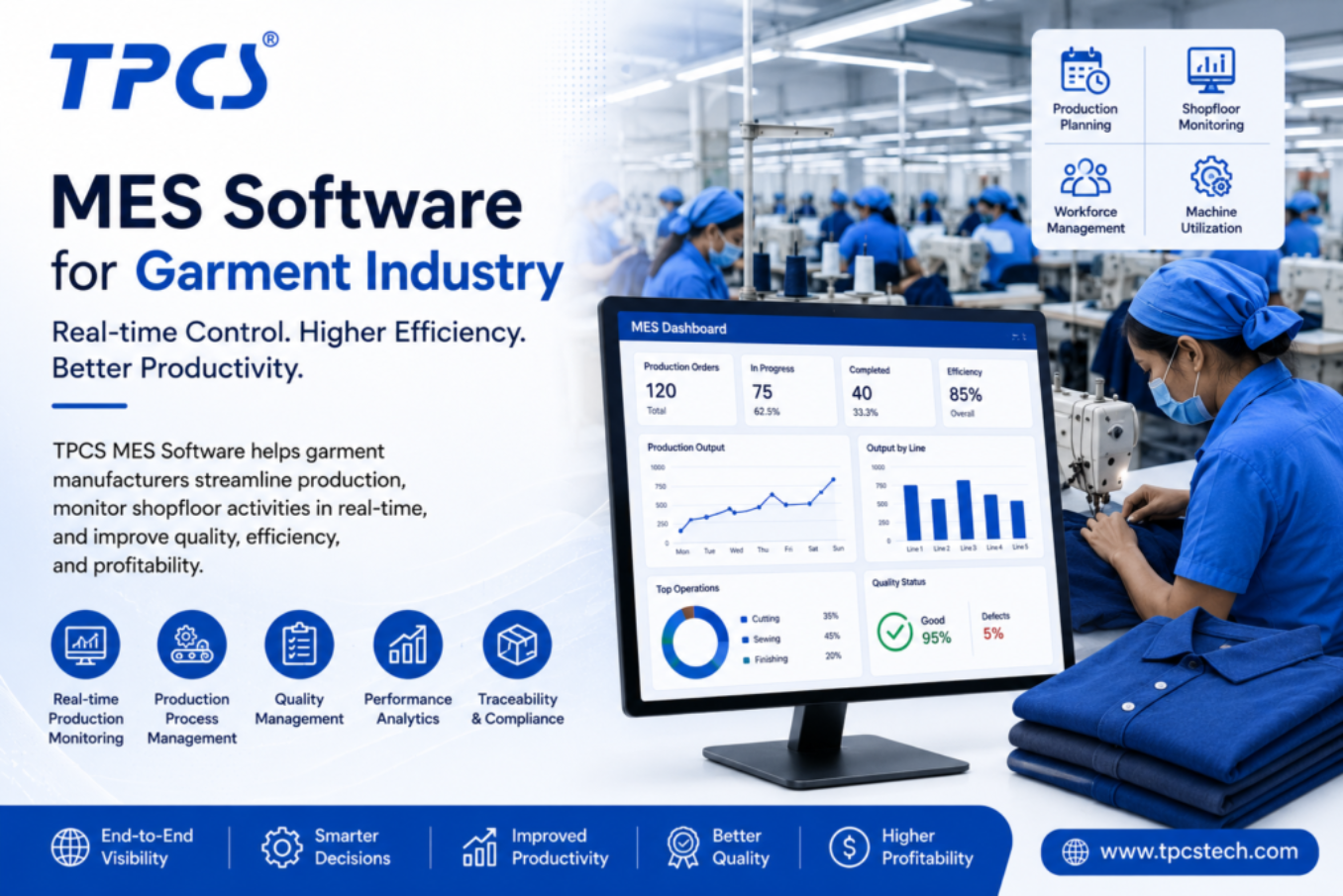
Real-Time Shop Floor Control for Garment Factories
Track every bundle, operator, and machine on the line — and connect that data directly to planning and costing, without manual reporting.
Running production floors for export units and domestic garment brands across India.
What Is MES Software for the Garment Industry?
MES (Manufacturing Execution System) software for the garment industry tracks work-in-progress, operator efficiency, and line output in real time on the factory floor. TPCS MES connects that shop floor data directly to planning, costing, and dispatch, so production status is visible the moment it changes.
When Shop Floor Data Arrives Too Late to Act On
Most garment factories still measure line performance through end-of-shift paper reports. By the time a bottleneck or efficiency drop shows up on a spreadsheet, the delay has already cost a shipment date.
No Real-Time WIP Visibility
Managers see production status only in end-of-day reports, long after a bottleneck could have been fixed.
Manual Efficiency Reporting
Operator and line efficiency is calculated by hand from paper tally sheets, hours after the shift ends.
Untracked Jobwork & Subcontracting
Materials issued to outside units for printing, embroidery, or washing are tracked manually, hiding wastage and delays.
Delayed Bottleneck Detection
Line imbalances and machine downtime surface only after they’ve already affected the day’s output.
Disconnected Shop Floor and Planning Data
Production status doesn’t feed back into planning, so schedules run on outdated assumptions.
Manual Packing & Dispatch Reconciliation
Packing lists are matched against orders by hand, increasing the risk of shipment errors.
Production Data That Updates the Moment It Happens
TPCS MES captures shop floor activity through QR codes and barcodes as it happens, then feeds that data directly into planning, costing, and dispatch — replacing the lag of paper-based reporting.
| Stat | What It Means | Why It Happens |
|---|---|---|
| 30% | Faster Bottleneck Identification | Live line dashboards flag imbalances and downtime as they occur, not after the shift ends. |
| 25% | Better Line Efficiency Visibility | Operator-wise output is captured automatically through QR-code scans instead of paper tally sheets. |
| 50% | Less Manual Efficiency Reporting Time | Automated data capture removes hours of manual reconciliation per shift. |
| 20% | Fewer Dispatch Errors | Scan-and-pack workflows match cartons against orders automatically before shipment. |
| 100% | QR-Code Based WIP Traceability | Every bundle is tracked from cutting through finishing and packing. |
Export units and domestic garment brands across India run daily shop floor operations on TPCS MES.
Every Shop Floor Function, In One Suite
QR/Barcode WIP Tracking
Track every bundle from cutting to packing using mobile or tablet scans.
- Assign QR codes at cutting and scan bundle movement through every process.
- See live WIP status by line, style, and process stage.
- Flag stuck or delayed bundles automatically for supervisor action.
- Eliminate manual bundle registers and paper movement cards.
Line Balancing & Operator Efficiency
See operator and line output live, not at end of shift.
- Capture operator-wise output automatically through scan data.
- Live line displays show target versus actual output in real time.
- Efficiency reports update continuously through the shift, not just at close.
- Identify skill gaps and line imbalances while there is still time to act.
Machine & Maintenance Monitoring
Track machine downtime and maintenance history alongside production data.
- Log machine downtime reasons and duration against the affected line.
- Maintain preventive maintenance schedules tied to actual machine usage.
- Correlate downtime patterns with efficiency drops for faster root-cause analysis.
- Reduce unplanned stoppages through visibility into recurring machine issues.
Jobwork & Subcontracting Control
Track materials issued to outside units with the same visibility as in-house production.
- Issue and receive jobwork materials digitally, with vendor-wise tracking.
- Monitor jobwork WIP status for printing, embroidery, washing, and finishing.
- Generate wastage and rejection reports per subcontracting vendor.
- Flag overdue jobwork returns before they delay the shipment date.
Scan-and-Pack Dispatch
Match finished cartons against orders automatically before shipment.
- Scan finished units using customer barcodes during packing.
- Auto-generate packing slips and dispatch reports without manual collation.
- Reconcile packed quantity against order quantity before dispatch confirmation.
- Reduce shipment errors caused by manual carton counting.
Live Production Dashboards
Give managers one live view of every line, order, and bottleneck.
- Real-time dashboards for WIP status, efficiency, and jobwork position.
- CEO Dashboard for a single view of production performance across factories.
- Custom MIS reports for production, planning, and management teams.
- AI-based scheduling flags predicted delays before they affect ex-factory dates.
ROI / CTA Banner
Factories running TPCS MES alongside SAP or legacy ERP catch bottlenecks earlier and cut manual reporting time from day one.
Frequently Asked Questions — TPCS MES Software for Garment Industry
- What is MES software for the garment industry?
MES software tracks production in real time on the shop floor — bundle movement, operator efficiency, and machine status — and feeds that data back into planning and costing. It replaces end-of-shift paper reporting with live visibility.
- What is the difference between MES and ERP for a garment factory?
ERP manages planning, purchasing, and finance at the order level. MES captures what actually happens on the shop floor — bundle-by-bundle, operator-by-operator — and feeds that live data back into the ERP for accurate planning.
- Does TPCS MES track jobwork and subcontracting?
Yes. Materials issued to outside units for printing, embroidery, washing, or finishing are tracked digitally, with vendor-wise wastage and return reports, giving the same visibility as in-house production.
- What hardware is needed to run TPCS MES on the shop floor?
TPCS MES runs on standard Android tablets or mobile devices with a camera for QR/barcode scanning. No specialized industrial hardware is required to get started.
- How long does implementation take?
Most garment factories go live on TPCS MES within 4–6 weeks, including QR-code setup, line configuration, and operator training, with measurable efficiency gains within the first production cycle.
- Does TPCS MES integrate with our existing ERP?
Yes. TPCS MES can run as part of the full TPCS platform or connect with SAP, Tally, and other ERP systems, passing shop floor data directly into planning and costing.
Brand Conclusion
Shop floor delays rarely come from a single bad shift — they come from managers finding out about a problem a full day after it started. TPCS MES closes that gap by capturing bundle movement, operator output, and machine downtime the moment it happens, not at end-of-shift reconciliation. Factories that run MES disconnected from planning still react to yesterday’s numbers. Start with QR-code bundle tracking on your busiest line first — efficiency visibility and faster dispatch follow directly from that foundation.