
What to Look for in Garment Costing Software?
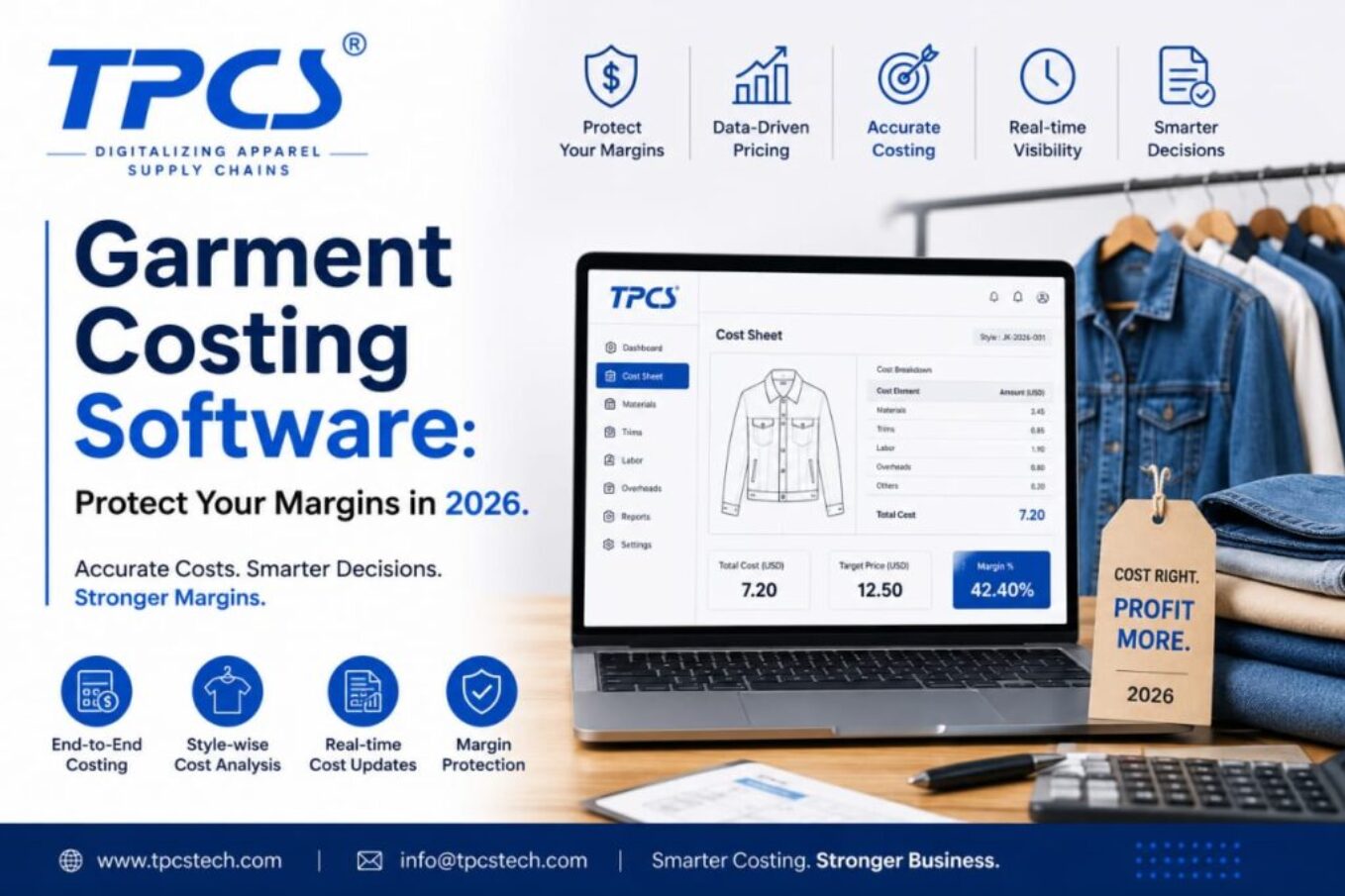
Garment costing software calculates the true landed cost of a garment — fabric, trims, labor, overhead, duty and freight — directly from its bill of materials, so the cost sheet updates the moment a spec, quantity or rate changes.
It replaces the version of costing that lives in someone’s personal spreadsheet.

The distinction that matters is *live* versus *static*. A spreadsheet cost sheet is a snapshot: accurate on the day it was built, and quietly wrong every day after that as fabric prices move, a trim vendor changes rates, or a duty schedule shifts.
Costing software ties the cost sheet to the same BOM and rate masters the rest of the business uses, so a rate change in one place updates every open quote that depends on it.
KEY TAKEAWAYS (TL;DR)
● Garment costing software builds a live cost sheet from your BOM, so fabric, trim and labor costs update automatically instead of sitting in a spreadsheet someone forgot to refresh.
● The Apparel, Footwear & Accessories industry reported a trailing-twelve-month gross margin of 50.12% as of Q1 2026 — down from 50.55% the prior quarter (CSIMarket, 2026).
● McKinsey’s State of Fashion 2026 puts US tariff-driven sourcing cost increases at roughly 35% for apparel and 37% for leather goods — the single biggest new variable in every 2026 cost sheet.
● Factory gross margins commonly run 10–25%, compressing to 8–12% on commodity basics (OneAim quote data, 2024–2026) — thin enough that one costing error can erase a season’s profit on a style.
● A connected costing system turns a buyer’s spec into a defensible quote in hours, not days, because fabric, trim and labor rates are already live in the system rather than re-keyed each time.
Why manual costing sheets cost you money
Manual costing is not just slow — it is a direct margin risk, and 2026’s tariff environment has made that risk far more expensive.
According to McKinsey’s State of Fashion 2026 report, US tariffs are driving short-term sourcing price increases of approximately 35% for apparel and 37% for leather goods, with country-specific duty rates above 35% on several major Asian sourcing markets.
A cost sheet built even a few weeks ago, before the latest duty update, can misprice a style badly enough to turn a profitable order into a loss.

Layer on the fact that importer-side costs — freight, duty and inspection — average around 23% of FOB on Asian sourcing, a line item OneAim’s 2024–2026 quote data shows founders and merchandisers routinely under-budget by 15–20%.
On factory gross margins of 10–25%, compressing to 8–12% on commodity basics, that under-budgeted 15–20% is not a rounding error — it can be the entire margin on the order.
Manual costing compounds this in a second way: it is not auditable.
When a cost sheet is a spreadsheet on someone’s laptop, there is no record of which fabric rate, which wastage percentage, or which duty assumption produced a given quote — which makes it nearly impossible to diagnose why a style underperformed its target margin after the fact.
The anatomy of an accurate BOM & cost sheet
An accurate garment cost sheet is built line by line from the bill of materials, not estimated top-down. Every component the BOM lists needs a costed line: fabric consumption per size and colorway , trims and accessories at current vendor rates, CMT labor by operation, and overhead allocation.
On top of that sits the importer-side layer — duty, freight and inspection — which is where most manual cost sheets go stale fastest, since these rates change with trade policy rather than with the garment itself.
See for how the underlying bill of materials should be structured so costing has something reliable to calculate from — costing software is only as accurate as the BOM feeding it.
Fabric, trim & labor costing in one system
The point of dedicated costing software is that fabric, trim and labor rates live as shared master data, not as numbers re-typed into every new quote.
When a fabric mill revises a rate, or a trim vendor’s price changes, that update flows into every open cost sheet referencing it — instead of someone remembering to hunt down and fix each spreadsheet separately.
This matters most on colorway- and size-heavy styles, where a small consumption difference per size multiplies across an order.
A system that holds size curve and colorway data alongside the BOM (see the size curve and colourway detail in can cost each size and colorway combination accurately, instead of applying one blended average cost across a style that may run from XS to 3XL.
From costing to quotation: speeding up buyer response
A buyer’s RFQ has a shelf life, and the manufacturer that quotes accurately in hours wins orders the manufacturer that takes three days re-keying a spreadsheet does not.
For manufacturers and buying houses handling multiple concurrent RFQs, the bottleneck is rarely willingness to quote — it is the manual work of pulling current fabric, trim and labor rates together for every new spec.
When costing is connected to live rate masters, a merchandiser can turn a buyer’s tech pack into a costed quotation without re-sourcing every rate from scratch, and can show the buyer a transparent cost breakdown — fabric, trim, CMT, overhead, duty — rather than a single opaque number.
That transparency itself is often a competitive advantage with buyers who are comparing quotes from several factories.
What to look for in garment costing software
The features that actually protect margin, versus the ones that just look good in a demo:
- A cost sheet driven by the live BOM — not a parallel spreadsheet that has to be kept in sync manually.
- Size- and colorway-level consumption and costing, not one blended average per style.
- Editable duty, freight and inspection assumptions that can be updated centrally as trade policy shifts.
- Version history on every quote, so you can see which rate assumptions produced which price.
- GST-ready output for Indian manufacturers, and a clean handoff to Tally or SAP for finance.
- Fast quote turnaround for RFQ-heavy buying houses managing many styles at once.
How TPCS handles this
TPCS ties costing directly to the BOM, so fabric, trim and labor rate updates flow into every open quote automatically, with duty and freight assumptions editable centrally rather than buried in individual spreadsheets.
Costing output is GST-ready and flows straight into Tally or SAP, so finance is not re-keying quotation data into a second system (TPCS, 2026).
TPCS customer Alpine Shoes, an Adidas supplier, cut rejections 20% after rolling out TPCS ERP, MES and AQL together — a result that starts upstream, at accurate costing and BOM data, before it ever reaches the shop floor
FAQ: garment costing software
What is garment costing software?
Garment costing software calculates a garment’s true landed cost — fabric, trims, labor, overhead, duty and freight — directly from its bill of materials, updating automatically when a spec, rate or quantity changes.
How is costing software different from a spreadsheet cost sheet?
A spreadsheet is a static snapshot that drifts out of date as fabric, trim and duty rates change. Costing software ties the cost sheet to live rate masters, so every open quote updates when a rate does.
Can costing software handle sudden fabric or duty rate changes?
Yes, if the rate lives as shared master data. Update the rate once and every cost sheet referencing that fabric, trim or duty assumption reflects the change immediately.
Does garment costing software help with GST-compliant quotations?
A well-built one does. TPCS produces GST-ready costing output and hands it to Tally or SAP directly, so finance is not re-keying quotation data by hand.
How does costing software speed up RFQ response for buying houses?
By pulling current fabric, trim and labor rates from a shared master instead of re-sourcing them for every new spec, so a merchandiser can turn a tech pack into a costed quote in hours.
Does TPCS costing integrate with the BOM directly?
Yes — TPCS costing calculates from the same bill of materials used for production, including size- and colorway-level consumption, so the quoted cost and the produced cost are the same number.
The bottom line
Costing is where margin is won or lost — before a single meter of fabric is cut. In a year where McKinsey puts tariff-driven sourcing costs up 35–37% and industry gross margins sit around 50%, a cost sheet that is even a few weeks stale is a real financial risk, not a paperwork problem.
Build costing on top of an accurate, live BOM, keep duty and freight assumptions current, and insist on a system that can turn a buyer’s RFQ into a transparent, defensible quote in hours.
If you want costing that is connected to production data rather than parallel to it, that is what TPCS is built to do.
Instagram:https://www.instagram.com/