
Apparel Industry Software Trends 2026: What Manufacturers Need to Know
Apparel industry software trends 2026 are moving beyond individual features toward connected PLM, ERP and MES platforms. Manufacturers are also focusing on AI-assisted costing, tariff response, sustainability and traceability.
These changes are reshaping how apparel and footwear factories manage data, production and margins.
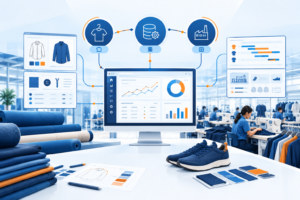
The clearest 2026 trend in apparel and footwear manufacturing software isn’t a new feature — it’s consolidation, as factories move away from stacking separate PLM, ERP and shop-floor tools and toward one connected platform. The reason is structural, not aesthetic:
every manufacturer in Kaufman Rossin’s 2026 mid-market research runs on an ERP, yet only 27% have a data warehouse or data lake, versus 60% across the broader mid-market, and 45% still operate with siloed data.
That siloed-data problem is exactly what point solutions create. A PLM tool that doesn’t talk cleanly to the ERP that doesn’t talk cleanly to shop-floor tracking means style, BOM, production and costing data all live in different systems that someone has to manually reconcile — the fashion-specific version of the legacy integration barrier that 55% of manufacturers cite as their top modernisation blocker.
KEY TAKEAWAYS (TL;DR)
● 94% of mid-market manufacturers now use generative AI in some form, but only 2% have operationalised it company-wide — legacy ERP integration and siloed data are the reasons cited most often (Kaufman Rossin, 2026).
● 87% of US manufacturers have yet to integrate AI into their operations at all, according to a Digit Software analysis of US Census Bureau data — a much larger gap between hype and shop-floor reality than headlines suggest.
● US tariffs are driving sourcing cost increases of roughly 35% for apparel and 37% for leather goods, and 76% of fashion executives named tariffs their defining 2026 concern in McKinsey’s State of Fashion survey — pushing digitisation from a nice-to-have to a margin-protection necessity.
● India’s textile and apparel sector is targeting US$100 billion in exports by 2030, up from roughly US$37 billion today — a growth trajectory that only factories with provable speed, traceability and quality will fully capture.
● The consistent thread across every 2026 trend is consolidation: unifying PLM, ERP and MES on one connected data layer is what makes AI, traceability and fast tariff response actually possible — point solutions bolted together can’t deliver any of the three.
AI-assisted costing & demand planning
AI adoption headlines in manufacturing are running well ahead of AI deployment reality, and 2026’s honest picture is a pilot-stage industry, not a transformed one. 94% of mid-market companies now use generative AI in some form, but only 2% have operationalised it company-wide — and a separate analysis of US Census Bureau data found 87% of US manufacturers have yet to integrate AI into their operations at all.
The blocker is consistent across surveys: legacy ERP integration, cited by 55% of manufacturers as their top barrier, and data quality and integration challenges topping the list in three separate 2026 surveys. AI-assisted costing and demand planning cannot run on data that’s split between a spreadsheet, a legacy ERP and a shop-floor logbook — the unified data layer has to exist before the AI feature does anything useful.
This is why software consolidation (see the previous section) is the real prerequisite for every AI capability apparel software vendors are marketing for 2026.
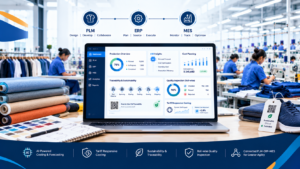
Tariff volatility is now a software problem, not just a sourcing problem
2026’s defining commercial pressure on apparel manufacturers is tariff volatility, and McKinsey’s State of Fashion 2026 survey found 76% of fashion executives expect tariffs to be the defining issue of the year, with efficiency as their second-biggest concern.
US tariffs are driving sourcing price increases of roughly 35% for apparel and 37% for leather goods — numbers large enough that a cost sheet or ERP system that can’t reflect a duty change quickly is now a direct margin risk, not an administrative inconvenience.
This is pushing costing and pricing agility from a back-office concern into a software selection criterion: factories are now asking, explicitly, whether a system can absorb a tariff-driven rate change across every open quote in hours rather than days.
Sustainability & traceability pressure on manufacturers
Traceability requirements — from buyer compliance programmes to emerging regulation — are pushing roll-wise QC and material-level tracking from a quality-control nice-to-have into a documented, audit-ready requirement.
A manufacturer that cannot show which fabric roll, which vendor and which inspection result went into a specific shipment is increasingly at a real disadvantage with global brand buyers who need that chain of custody documented, not just verbally assured.
This connects directly to the QC and inspection systems covered in — digital, roll-wise inspection records are what make traceability provable rather than aspirational, and 2026 is the year several major buyers are starting to ask for that documentation as a condition of the order, not a differentiator.
The India opportunity, and what it demands from software
For Indian manufacturers specifically, 2026’s trend picture is sharper than the global average: India’s textile and apparel sector is targeting US$100 billion in exports by 2030, up from roughly US$37 billion today, with the domestic-plus-export market projected to reach US$350 billion by 2030 (IBEF and Invest India, 2026).
The “China Plus One” sourcing shift is sending real order volume toward India — but only to factories that can prove speed, traceability and quality with data, not assurances.
That requirement points back to the same consolidation trend: GST-compliant, Tally-integrated, traceable, unified software is quickly becoming table stakes for factories that want to hold export orders through 2030, not just win them in 2026.
What this means for factories choosing software now
Every 2026 trend — AI, tariff response, traceability, India’s export growth — leads back to the same underlying requirement: one connected data layer across PLM, ERP and MES, rather than tools bolted together after the fact.
Factories evaluating software now should weight consolidation and integration as heavily as any individual feature, since a system that can’t unify style, costing, production and QC data will struggle to deliver on any of these trends individually, let alone all four at once.
FAQ: apparel industry software trends 2026
What is the biggest apparel manufacturing software trend for 2026?
Consolidation — moving from separate PLM, ERP and shop-floor tools toward one connected platform, because 45% of manufacturers still operate with siloed data and legacy integration is the top-cited barrier to modernising operations.
How widely has AI actually been adopted in manufacturing?
Adoption is much lower than headlines suggest. 94% of mid-market companies use generative AI in some form, but only 2% have operationalised it, and a separate analysis found 87% of US manufacturers haven’t integrated AI into operations at all.
Why are tariffs a software issue, not just a sourcing issue in 2026?
US tariffs are driving sourcing cost increases of roughly 35% for apparel and 37% for leather goods. A costing or ERP system that can’t reflect a duty change across open quotes quickly is now a direct margin risk.
How is traceability changing what QC software needs to do?
Traceability is moving from a quality nice-to-have to a documented requirement. Buyers increasingly want provable roll-wise inspection and material chain-of-custody data, not verbal assurance.
What does India’s export growth mean for factory software choices?
India is targeting US$100 billion in textile and apparel exports by 2030. Holding that order growth requires GST-compliant, traceable, unified software — factories without it will struggle to prove the speed and quality buyers require.
Does TPCS unify PLM, ERP and MES on one platform?
Yes — TPCS runs PLM, ERP, MES and WMS as one cloud platform, which is the consolidation model behind most of the 2026 trends covered here, from AI readiness to tariff-responsive costing to traceable QC.
The bottom line
2026’s apparel manufacturing software trends all point in the same direction: consolidation is no longer optional, because AI, tariff response and traceability all depend on one connected data layer that point solutions can’t provide.
The factories capturing India’s export growth and holding margin through tariff volatility will be the ones whose software already unifies style, costing, production and QC — not the ones bolting an AI feature onto a system still split across spreadsheets.
Start by asking whether your current stack can answer a tariff-driven costing question or a buyer’s traceability request in hours, not days. If you want a platform built around that connected data layer from the start, that is what TPCS is designed to do. See for the full picture of what that foundation should cover.
Instagram:https://www.instagram.com/