
The size 9 mould that was at the vendor
This is a composite scenario based on situations moulded-footwear plants describe to us.
A PU sandal plant confirmed a 20,000-pair order for a retail chain. Production started on time for most sizes. Size 9, the second-largest size in the order, stalled for four days. Its mould pair had been sent to the toolmaker for a surface repair two weeks earlier, and nobody had recorded the movement. The planner saw "mould set available" on the register and loaded the order.
Why moulds deserve their own system
They are expensive. A full size run of moulds for a new sole design is a large investment, and replacements take time to make.
They limit capacity by size. If you have one mould pair in size 9, size 9 output is capped at that mould's cycles per shift.
They wear out. Surface finish, venting and parting lines degrade with use, raising defects such as flash, short shots and surface marks.
They move. Moulds go to toolmakers for repair, to other plants, or back to the brand that owns them.
They have owners. Some moulds belong to the factory, some to the buyer or brand, and some to the sole supplier.
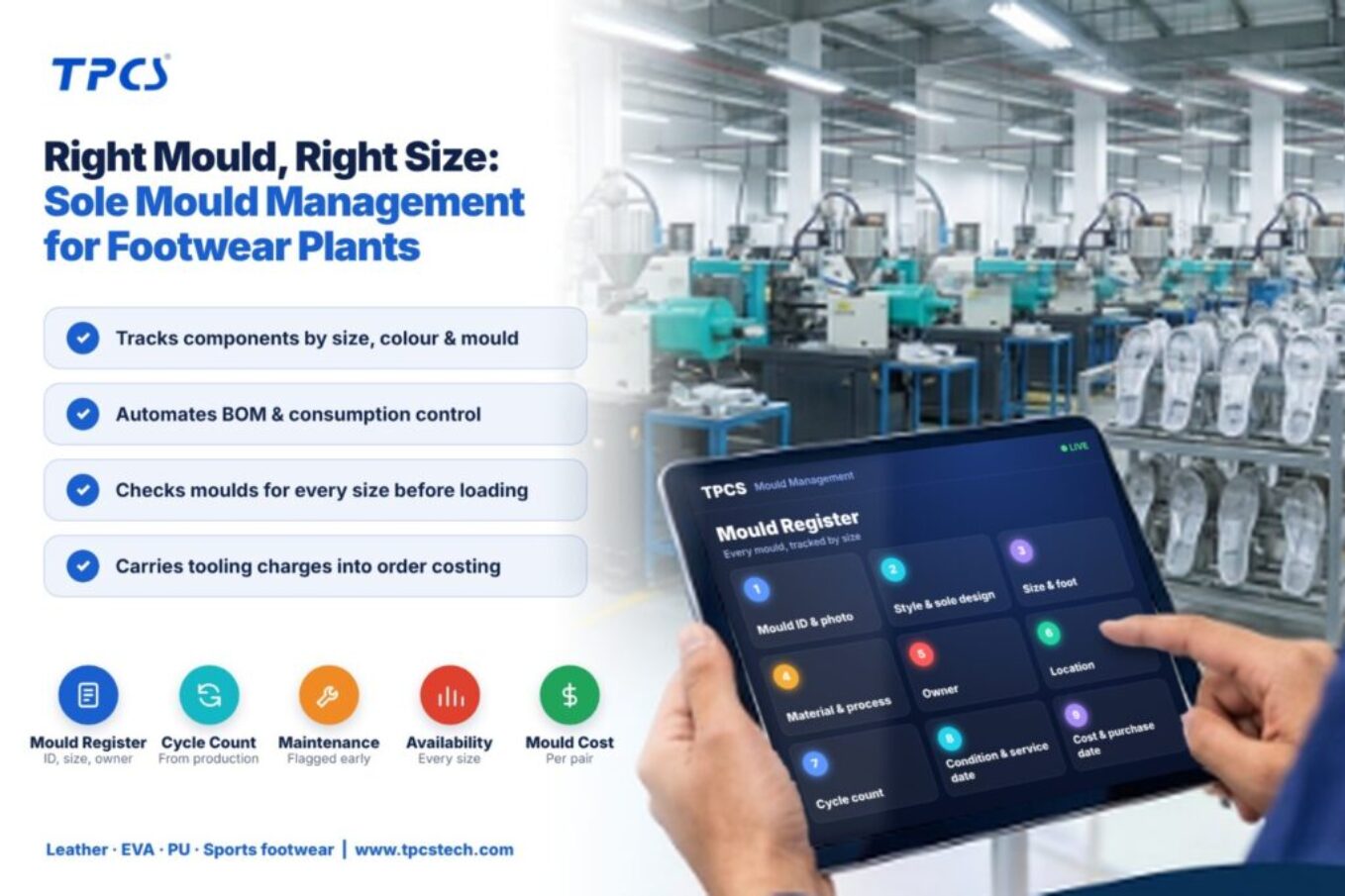
What a mould register should hold
| Field | Why it matters |
|---|---|
| Mould ID and photo | One identity per physical mould, visible on the floor |
| Style and sole design | Links the mould to BOMs and orders |
| Size (and foot, if left and right are separate) | Planning and availability by size |
| Material and process | DIP, PU, EVA, rubber or PVC; machine compatibility |
| Owner | Factory, buyer or supplier, for billing and return |
| Location | Rack, machine, toolmaker, other plant |
| Cycle count | Usage since new and since last maintenance |
| Condition and last maintenance date | Predicts defects and service needs |
| Cost and date of purchase | Costing and depreciation |
Count cycles, plan maintenance
Track cycles from production records: pairs produced on a mould divided by pairs per cycle. Set a maintenance interval by mould type and material based on your own defect history. When a mould reaches the interval, the system should flag it before the next order is loaded onto it, not after defects appear in final inspection.
Simple example: an EVA mould producing one pair per cycle at 4-minute cycles runs about 120 cycles in an 8-hour shift. If your experience shows surface cleaning is needed every 5,000 cycles, that is roughly every 42 shifts. Your own intervals will differ by material, temperature and mould quality.
Check mould availability before loading orders
Before confirming a production plan for moulded footwear, check for every size in the order:
1. Does a mould pair exist for this size?
2. Is it in the plant, or at a toolmaker or another plant?
3. Is it due for maintenance during the order?
4. Is it already booked on another order at the same time?
5. Is the number of moulds per size enough for the required daily output?
A size with one mould pair and a large share of the order needs more production days than the rest of the size run. Plan for it, or invest in a second mould pair for the busiest sizes.
Costing moulds into the pair
For factory-owned moulds, spread the mould set cost over its expected pairs:
Mould cost per pair = mould set cost ÷ expected pairs over the mould's life
New sizes or designs requested by a buyer often need new moulds. Agree upfront whether the buyer pays for tooling, or whether the cost is spread across the order, and record it in the cost sheet. Unrecorded tooling charges are one of the margin leaks in footwear costing.
How TPCS footwear ERP supports mould-driven production
TPCS footwear ERP tracks components by size, color and mould, and automates BOM creation and consumption control around them, according to the product FAQ. Because moulds, BOMs, orders and production live in one system, planners can see whether the right moulds exist for every size before an order is loaded, and costing can carry tooling charges against the order. The platform supports leather, EVA, PU and sports footwear with category-specific material, process and costing logic.
Frequently asked questions
How many moulds does one shoe style need?
Usually one mould pair per size in the run, and more for high-volume sizes. A style sold in 8 sizes may need 8 or more mould pairs.
What is mould life in footwear manufacturing?
The number of cycles a mould can run before it needs major repair or replacement. It depends on material, process temperature, mould construction and maintenance.
How do you track sole moulds in a factory?
With a register that gives each mould an ID, style, size, owner, location, cycle count and maintenance history, updated from production records.
Who owns sole moulds: the factory or the brand?
It varies. Brands often pay for and own moulds for their exclusive designs, while factories own moulds for their own or shared designs. Record ownership for every mould.
How do moulds affect production planning?
The number of moulds per size caps how many pairs of that size can be made per shift, so planning must check mould availability as well as machine capacity.
Plan moulded footwear by mould, not just by machine
Book a TPCS footwear ERP demo to see size-wise BOMs, mould-linked components and order planning together.
Sources
TPCS Footwear ERP product page (component tracking by size, color and mould; supported footwear categories): tpcstech.com/footwear-erp, checked November 2026