
The cost of waste in a thin-margin business
India's leather and footwear exports fell 1.66% to $4.75 billion in FY2025-26, according to DGCI&S data reported by APLF, even though rupee earnings rose 2.62%. With leather footwear exports alone at $1.95 billion, even a one or two point cut in material waste is worth more to most exporters than a small price increase they may not be able to win from buyers.
Where waste happens
| Material | Main waste points | Control |
|---|---|---|
| Leather | Cutting loss above standard; weak lots; poor nesting; recuts after defects | Lot grading at receipt; yield tracked by lot and cutter; recuts recorded |
| Linings and synthetics | Cut from wide rolls without planning; offcuts unused | Lay planning; offcut use for small components |
| Soles and insoles | Over-ordering in small sizes; dead stock after order cuts | Size-wise MRP; reservation against orders |
| Components (toe puffs, counters) | Loose issue; size mix-ups | Issue by size against cutting slips |
| Adhesives and primers | No grams-per-pair standard; open containers drying out | Standards by construction; controlled dispensing |
| Packing | Boxes printed for cancelled ratios | Print against confirmed packing plans |
| Finished pairs | Rejections, odd pairs | Inline QC; pair matching |
Leather: the biggest lever
Leather is usually the most expensive material in a leather shoe, and every hide is different. Four practices make the biggest difference:
1. Grade every lot at receipt. Record area, grade, thickness and shade group.
2. Set planned yield by lot grade. A lower-grade lot should carry a higher planned loss, so the cost sheet and the cutter's target are realistic.
3. Track yield by cutter and lot. Yield = net component area ÷ gross area issued. Share results weekly.
4. Record recuts. Components recut after closing or lasting defects are real consumption and must be charged to the order.
Example: on a 6,000-pair order needing 1.4 sq ft of net leather per pair, cutting at 22% loss instead of a planned 18% uses about 525 sq ft more leather (8,400 ÷ 0.78 − 8,400 ÷ 0.82). At ₹120 per sq ft, that is about ₹63,000 on one order.
Adhesives: small per pair, large per year
Adhesive and primer are often missing from BOMs entirely. Set a standard in grams per pair for each construction and sole type, measure actual consumption per batch or per shift, and keep containers closed to stop solvent loss. A few grams per pair across hundreds of thousands of pairs a year adds up.
Issue control: stop over-issue at the store
Issue materials against cutting slips and job cards that carry the order's size ratio.
Record returns of unused material by order, so the next issue uses returned stock first.
Use barcode issue and return so every movement is linked to an order.
Compare issued with BOM consumption on every order close.
Purchasing: waste that starts before production
Buying soles, insoles and components in the wrong sizes creates dead stock that is wasted even if it never reaches the floor. Size-wise MRP and order reservations prevent most of it. See MRP for footwear factories for the details.
A 30-day wastage reduction plan
1. Week 1: measure baseline leather yield and adhesive use on three running orders.
2. Week 2: start lot grading at receipt and issue against cutting slips.
3. Week 3: add grams-per-pair adhesive standards and record recuts.
4. Week 4: compare BOM vs actual on closed orders and review results with cutters and supervisors.
How TPCS footwear ERP reduces wastage
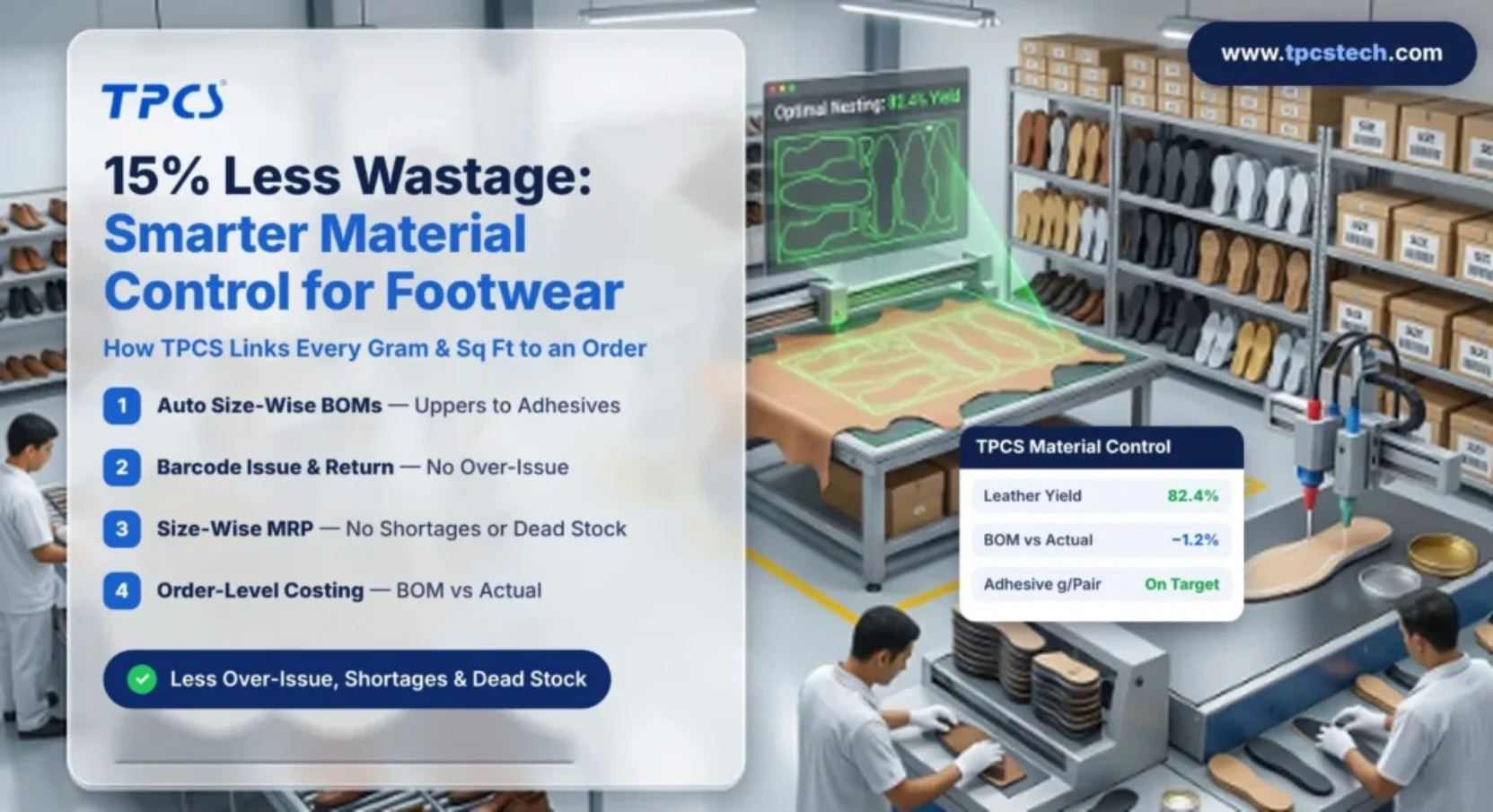
TPCS footwear ERP uses automatic size-wise BOMs that track uppers, soles, linings and adhesives to prevent over-issue and shortages. TPCS publishes a figure of 15% lower material wastage for this. Combined with barcode issue and return, size-wise MRP and order-level costing, every gram and square foot is linked to an order. Treat the 15% as the vendor's claim, and compare it with your own baseline from week 1 of the plan above.
Frequently asked questions
What is the biggest source of waste in shoe manufacturing?
In leather footwear, leather cutting loss. In moulded footwear, compound overflow, rejects and dead stock of soles in unused sizes.
How can a shoe factory reduce leather wastage?
Grade lots at receipt, set planned yield by grade, track yield by cutter and lot, record recuts and issue leather against cutting slips.
How much adhesive does a pair of shoes use?
It depends on construction, sole type and process. Set your own grams-per-pair standard by construction and measure against it.
Does ERP reduce material wastage in footwear?
It helps by issuing materials against size-wise BOMs, linking every issue to an order and showing consumption variance while production is running.
What is consumption variance in footwear?
The difference between actual material used on an order and the BOM standard, expressed as a percentage.
Find out where your materials really go
Book a TPCS footwear ERP demo and we'll compare BOM and actual consumption on one of your recent orders.
Sources
DGCI&S export data for FY2025-26, via APLF, June 2026
TPCS Footwear ERP product page (size-wise BOM, 15% wastage claim): tpcstech.com/footwear-erp, checked November 2026