
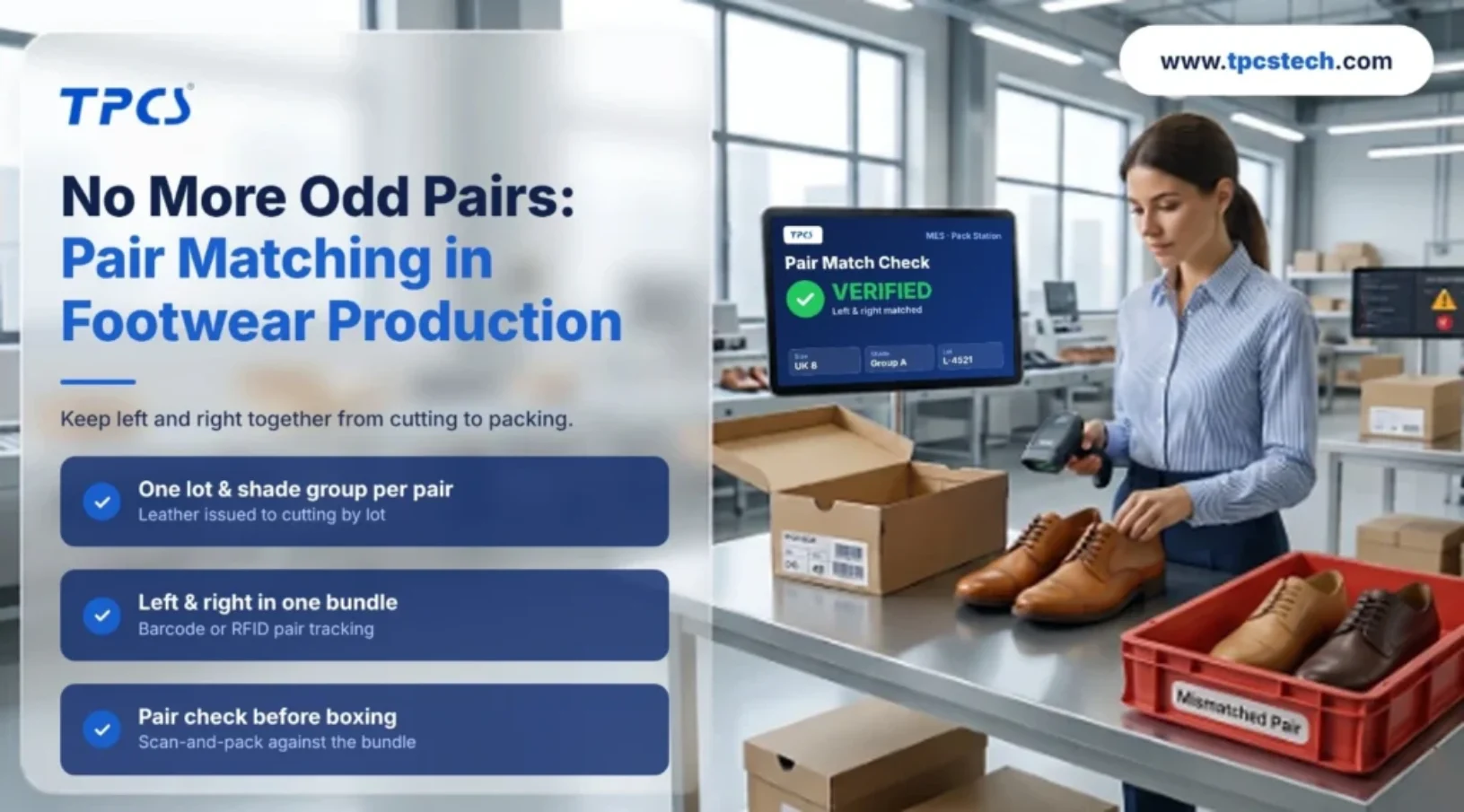
Why odd pairs are so costly
A mismatched pair is not a small defect. The end customer notices it immediately, the retailer returns it, and buyers often treat it as a major or critical defect at final inspection. A few odd pairs in a sample can fail a whole lot. Then there's the hidden cost: the remaining single shoes in the factory, which need a matching partner or become waste.
Where odd pairs come from
| Stage | How mismatch happens | Typical result |
|---|---|---|
| Cutting | Left and right components cut from different leather lots or shade groups | Visible shade difference in the box |
| Bundling | Left and right uppers split into different bundles | Left and right lasted on different days, on different lasts |
| Closing | Bundles mixed between operators or jobworkers | Wrong size or color combined |
| Lasting | Lasts of neighbouring sizes mixed on the rack | One shoe half a size different |
| Sole attaching | Soles of different batches or sizes picked from loose stock | Sole color or size mismatch |
| Finishing and packing | Loose shoes paired by eye at the packing table | Two lefts, or different sizes, in one box |
Six controls that prevent odd pairs
1. Group leather by shade at receipt. Record shade groups for every lot and issue one group per cutting slip.
2. Cut a pair from one lot and shade group. The cutting slip should carry the lot number so the pair stays traceable.
3. Bundle left and right together. One bundle, one size, both feet, one barcode or QR tag that follows it through every department.
4. Control last racks by size. Label racks clearly by size and check last size at the lasting input scan.
5. Issue soles by size and batch against the bundle. No loose picking from mixed bins.
6. Check pairs before boxing. Size, color, shade and construction checked side by side, with the box label scanned against the bundle.
Pair tracking with barcodes and RFID
Barcode bundle tracking keeps left and right together as long as both move as one bundle. For higher volumes or more complex footwear, RFID component tracking goes further: each component or shoe carries a tag, so the system can confirm that a left and right belong together before packing. Footwear pair tracking and odd-pair matching are listed as part of the MES add-on on the TPCS pricing page.
What to do with odd shoes already in the factory
Record every single shoe by style, size, color, foot and shade group, rather than leaving them in a corner.
Match them against later production of the same style and shade before cutting new pairs.
Track the count each month. A growing pile of singles is a sign that one of the six controls is not working.
A quick check you can run this week
Pick one finished order and count:
| Check | Target |
|---|---|
| Pairs with visible shade difference in a sample of 100 boxes | 0 |
| Boxes with size or foot errors in the same sample | 0 |
| Single shoes left over after packing the order | As close to 0 as possible |
| Bundles split across two days at lasting | Rare, and recorded |
If any of these numbers is above zero, trace the pairs back to the stage where they were split.
How TPCS footwear ERP supports pair matching
TPCS footwear ERP with pair tracking links leather lots, cutting slips, bundles and packing in one system:
Leather issued to cutting by lot through barcode or RFID issue.
Cutting slips and job cards with barcodes that keep pairs together through each department.
RFID component tracking, footwear pair tracking and odd-pair matching in the MES add-on.
Scan-and-pack with customer barcodes before dispatch.
Frequently asked questions
What is an odd pair in footwear?
A pair where the left and right shoes don't match in size, shade, last, construction or foot.
What causes shade mismatch in leather shoes?
Cutting left and right components from different leather lots or shade groups. Shade grouping at receipt and cutting a pair from one group prevents it.
How do factories prevent odd pairs?
By keeping left and right together in one bundle from cutting to packing, controlling last racks and sole issue by size, and checking pairs before boxing.
Can RFID prevent mismatched shoes?
RFID tags on components or shoes let the system confirm a left and right belong together before packing, which helps in high-volume or complex production.
Is an odd pair a major defect at final inspection?
Buyers usually treat mismatched pairs as a serious defect. Check your buyer's quality manual for how they classify it.
Keep every pair together from cutting to carton
Book a TPCS footwear ERP demo to see lot-wise cutting, bundle tracking and pair checks before packing.
Sources
TPCS plans and pricing (MES add-on: RFID component tracking, footwear pair tracking and odd-pair matching): tpcstech.com/pricing, checked November 2026
TPCS Footwear ERP product page (barcode and RFID issue, scan-and-pack): tpcstech.com/footwear-erp