
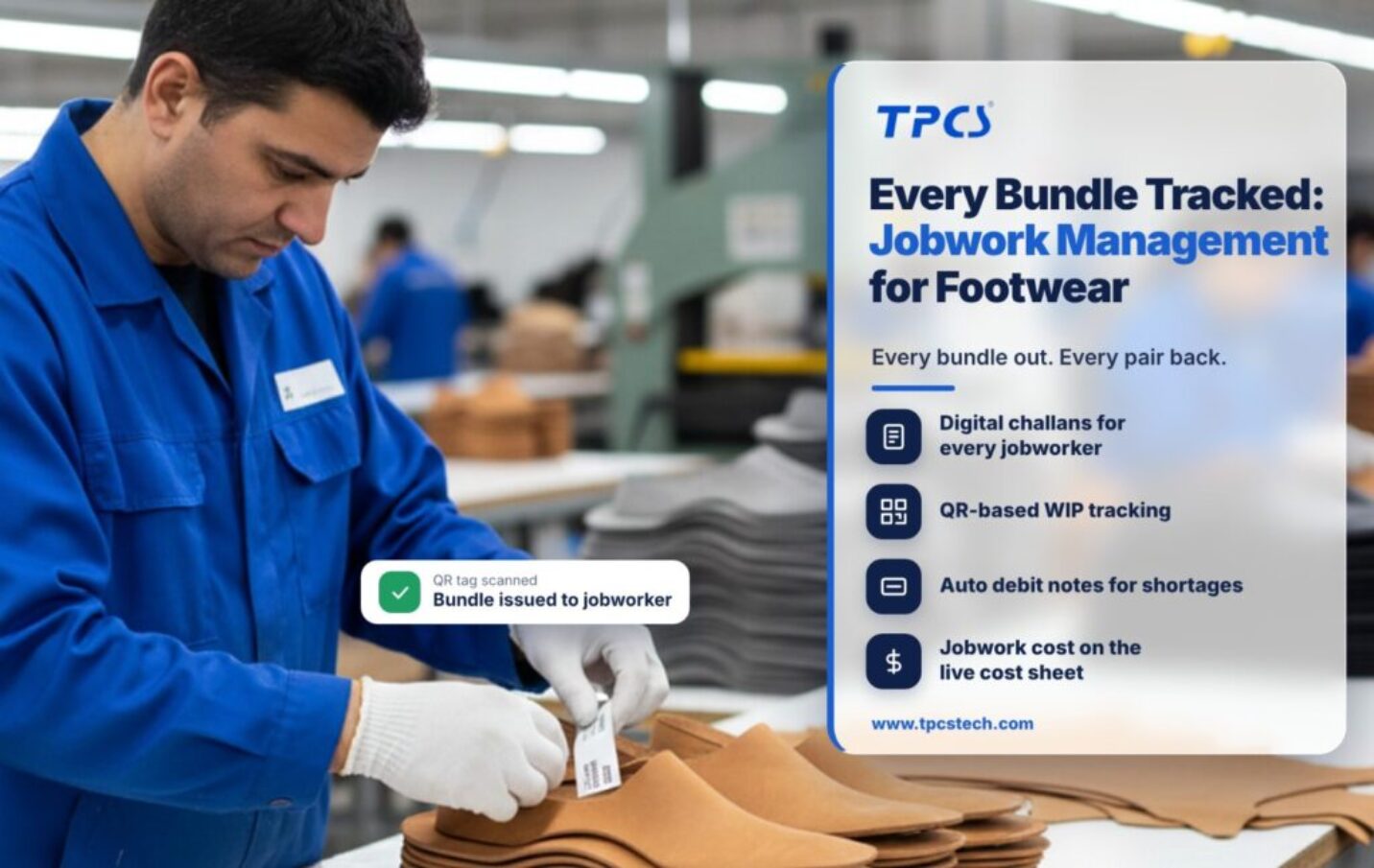
400 uppers that went missing for a week
This is a composite scenario based on situations footwear factories describe to us.
An Ambur shoe unit sent 2,400 pairs of cut uppers to three stitching contractors for closing. The challans were handwritten. When the uppers came back over the next ten days, the store counted 2,000 pairs. One contractor said he had returned everything; the challan copy had a different count; nobody knew which sizes were short.
The lasting line waited while two people spent a day reconciling paper. In the end, 180 pairs were found at a contractor's second shed and 220 pairs had to be recut.
Common jobwork operations in footwear
| Operation | Typical reason to outsource | What to track |
|---|---|---|
| Upper closing (stitching) | Seasonal peaks, specialist skills, cost | Cut components issued by size; uppers received by size; rejections |
| Embroidery and printing | Specialist machines | Components issued and returned; design and color accuracy |
| Hand stitching or moccasin work | Specialist craft | Pairs issued and returned; quality grade |
| Sole moulding or pressing | No in-house mould or press capacity | Material issued by weight; soles returned by size |
| Sole attaching and finishing | Overflow capacity | Lasted uppers issued; finished pairs returned |
| Leather finishing or splitting | Tannery or specialist unit | Area issued and returned; shade and thickness |
The jobwork cycle, done properly
1. Create the jobwork order. Link it to the production order, style, colorway and size breakdown.
2. Issue material with a digital challan. Record components by size and count, with a barcode or QR code on each bundle.
3. Track work at the jobworker. Know which bundles are at which unit, and since when.
4. Receive by size and check quality. Count returned pairs by size, inspect them, and record good, rework and rejected quantities.
5. Reconcile. Compare issued, returned, rejected and balance quantities per size. Any shortage is raised against the jobworker.
6. Pay against good pairs. Release jobwork payments only for accepted pairs, with automatic debit notes for shortages and rejections.
7. Close the loop with GST. In India, goods sent for jobwork must be reported (for example through Form ITC-04), so physical records and tax records should agree.
A simple reconciliation check
| Size | Issued (pairs) | Received good | Rework | Rejected | Balance at jobworker |
|---|---|---|---|---|---|
| 40 | 400 | 380 | 10 | 4 | 6 |
| 41 | 600 | 560 | 18 | 6 | 16 |
| 42 | 600 | 570 | 12 | 8 | 10 |
| 43 | 500 | 470 | 12 | 5 | 13 |
| 44 | 300 | 280 | 8 | 3 | 9 |
| Total | 2,400 | 2,260 | 60 | 26 | 54 |
The balance column is what matters. If it does not go to zero within the agreed time, those pairs are lost or misplaced, and the cost belongs on the jobworker's account, not hidden in factory wastage.
Measuring jobworker performance
Track each outside unit on the same few numbers every month:
On-time return rate: jobwork lots returned within the agreed days.
Rejection rate: rejected pairs ÷ pairs received.
Shortage rate: pairs not returned ÷ pairs issued.
Cost per pair: jobwork charges ÷ good pairs.
Units with high rejection or shortage rates cost more than their rate card suggests.
How TPCS footwear ERP handles jobwork
TPCS footwear ERP with jobwork tracking treats outside work as part of production, not a side register:
Digital material issue and receipt for every jobworker.
QR-based WIP tracking for in-house and jobwork operations.
Vendor performance monitoring from one dashboard.
Automatic debit notes for rejections or shortages.
Jobwork costs posted to the order's live cost sheet as soon as they are entered.
For a deeper look at multi-stage jobwork across textiles and footwear, see our guide to jobwork tracking software.
Frequently asked questions
What is jobwork in footwear manufacturing?
It is any manufacturing operation, such as upper stitching, embroidery or sole pressing, that a footwear factory sends to an outside unit while keeping ownership of the materials.
How do you track uppers sent for stitching?
Issue cut components by size with a digital challan and barcode or QR tags, then receive and inspect returned uppers by size and reconcile issued against returned quantities.
How should jobworkers be paid?
Against good pairs received and accepted, with shortages and rejections deducted through debit notes.
Do footwear jobwork movements need GST documentation in India?
Yes. Goods sent to and received from jobworkers must be documented and reported under GST rules, so jobwork records should match tax filings.
Can ERP software track jobwork in real time?
Yes. Footwear ERP systems with QR or barcode scanning show which bundles are at which jobworker and since when.
Track every pair at every jobworker
Book a TPCS footwear ERP demo and see issue, receipt, rejections and payments for one jobwork order end to end.
Sources
TPCS Footwear ERP product page (jobwork tracking, debit notes, vendor performance): tpcstech.com/footwear-erp, checked November 2026
Central Board of Indirect Taxes and Customs, GST Form ITC-04 for goods sent to jobworkers: cbic-gst.gov.in