
India makes a lot of both
India is the world's second-largest footwear producer, at about 3 billion pairs in 2025 (12.2% of global output), behind China's 13.7 billion pairs, according to the World Footwear Yearbook 2026 from APICCAPS. Export data from DGCI&S, reported by APLF, shows leather footwear at $1.95 billion and non-leather footwear at $262 million in FY2025-26. Set against 3 billion pairs of production, those export figures show how much of India's output, including non-leather footwear from clusters such as Bahadurgarh, is sold at home.
The point for software is simple: a leather shoe plant in Ambur and an EVA slipper plant in Bahadurgarh run very different operations, and one ERP template will not fit both.
Category comparison at a glance
| What matters | Leather shoes | PU / PVC (poured or injected) | EVA (injection or compression) | Rubber | Sports footwear |
|---|---|---|---|---|---|
| Main raw materials | Finished leather by area, linings, components | Polyol, isocyanate or PVC compound by weight; uppers | EVA compound by weight; straps or uppers | Rubber compound by weight; fabric or uppers | Mesh, synthetics, foams, moulded soles, many trims |
| Key consumption unit | Square feet per pair | Grams per pair per size | Grams per pair per size | Grams per pair per size | Mix of area, pieces and grams |
| Core process | Cutting, closing, lasting, sole attaching | Mould pouring or injection onto uppers or as soles | Moulding, curing, trimming | Mixing, moulding, vulcanising | Cutting, stitching or bonding, lasting, bonding soles |
| Capacity driver | Lasting line and skilled labor | Machine stations and moulds per size | Moulds per size and cycle time | Press capacity and cure time | Assembly lines and component readiness |
| Typical yield issue | Leather cutting loss by lot | Overflow, short shots, density variation | Flash, shrinkage, density variation | Flash, under-cure | Component mismatches, bonding failures |
| Quality focus | Grain defects, shade matching, stitching, sole bond | Density, hardness, bond to upper | Hardness, shrinkage, finish | Hardness, abrasion, cure | Bond strength, fit, performance specs |
What a leather footwear ERP must do
Track leather by lot, shade, grade and area, and issue to cutting by lot.
Calculate size-wise consumption with cutting loss from your own history.
Handle many labor operations in closing and lasting, with piece rates where used.
Track jobwork for closing and hand stitching.
Support traceability from hide lot to finished pair. For tannery-side needs, see our leather ERP guide.
What a PU, EVA or rubber footwear ERP must do
Treat compounds as weight-based materials, with batch and expiry where relevant.
Hold a grams-per-pair standard for each size and compare it with actual consumption from weighed batches.
Track moulds by style and size, with cycle counts and maintenance (see sole mould management).
Plan capacity by machine stations, moulds per size and cycle time.
Record scrap and regrind where your process allows reuse.
What a sports footwear ERP must do
Manage BOMs with many components, colorways and suppliers per style.
Lock technical specifications and approved materials per buyer.
Track component readiness, since one missing part stops a pair.
Keep test reports (bond strength, flex, abrasion) linked to production lots.
Compliance differs by category, too
In India, both leather and non-leather footwear fall under BIS Quality Control Orders, with separate orders for footwear made from leather and other materials, and footwear made from all rubber and all polymeric materials. Export buyers in the US and UK add their own testing and restricted-substance requirements. An ERP that links test reports and certificates to production lots makes audits faster. See our BIS QCO compliance guide.
How TPCS footwear ERP handles different categories
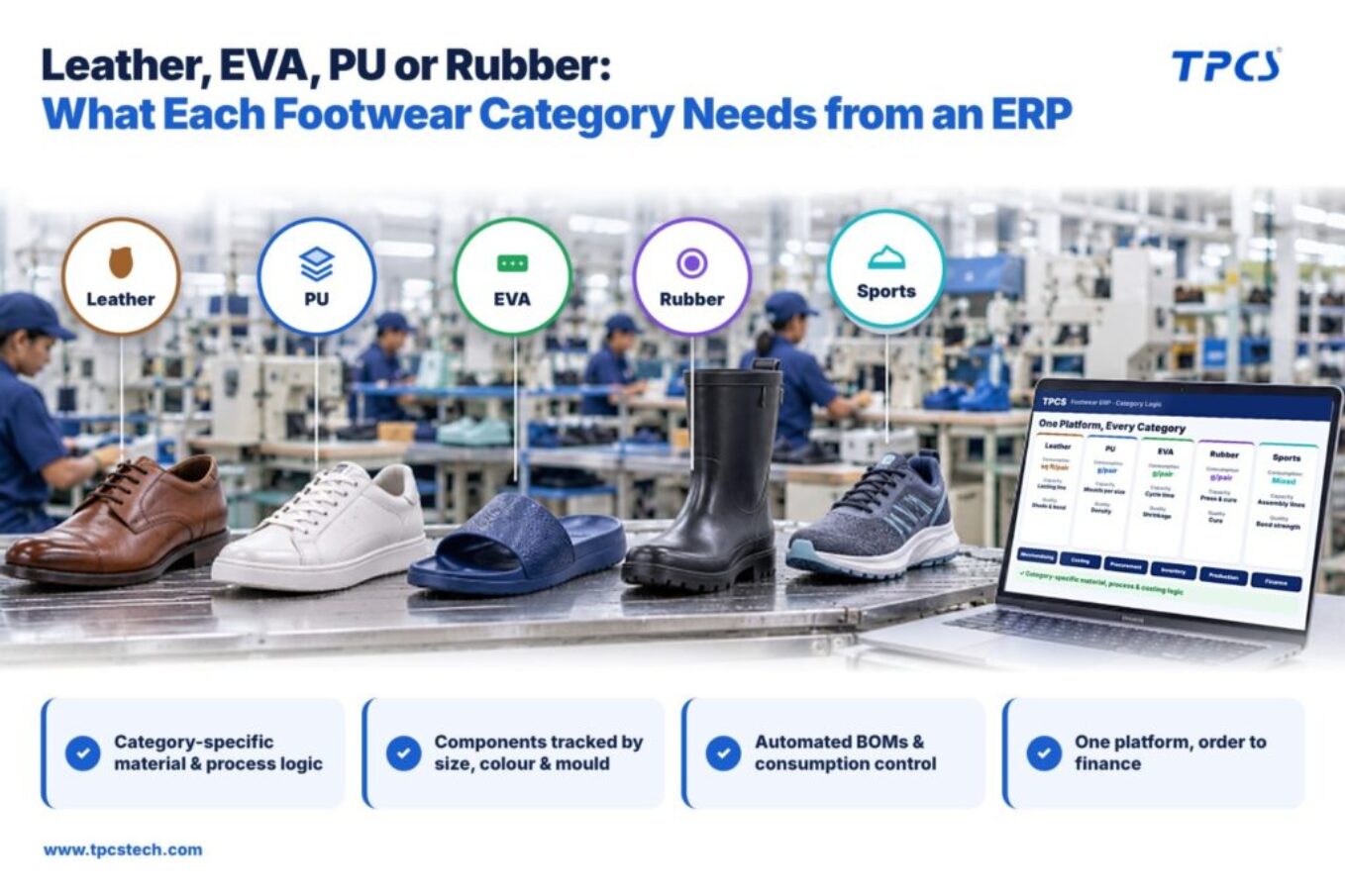
According to TPCS, its footwear ERP for leather, EVA and PU supports leather, EVA, PU and sports footwear, with category-specific material, process and costing logic. Components are tracked by size, color and mould, BOMs and consumption control are automated, and the same platform covers merchandising, costing, procurement, inventory, production, finance and reporting.
Frequently asked questions
Is ERP for PU footwear different from ERP for leather shoes?
Yes. PU and other moulded footwear is driven by weight-based compounds, moulds and machine cycles, while leather shoes depend on area-based leather control and labor-heavy operations.
How is material consumption measured in EVA footwear?
In grams per pair for each size, compared with actual compound weight used in each batch.
What is the biggest planning constraint in moulded footwear?
Usually the number of moulds per size and machine cycle time, rather than labor.
Does BIS QCO apply to non-leather footwear in India?
Yes. A separate Quality Control Order covers footwear made from all rubber and all polymeric materials and its components. Check the latest BIS notifications for categories and dates.
Can one ERP handle both leather and PU footwear?
Yes, if it supports category-specific material units, processes and costing, as footwear-specific ERP systems such as TPCS do.
See footwear ERP set up for your category
Book a TPCS footwear ERP demo for your product type, whether leather, PU, EVA, rubber or sports.
Sources
APICCAPS, World Footwear Yearbook 2026, via World Footwear, August 2026
DGCI&S export data for FY2025-26, via APLF, June 2026
Bureau of Indian Standards, footwear Quality Control Orders: bis.gov.in
TPCS Footwear ERP product page (supported categories): tpcstech.com/footwear-erp, checked November 2026