
This article explains general principles as of November 2026. Always confirm categories, standards and dates against the latest official BIS and Gazette notifications or with a compliance advisor.
What the footwear QCOs cover
| Order | Examples of covered products | Example standards cited |
|---|---|---|
| Footwear made from Leather and Other Materials (Quality Control) Order, 2024 | Leather shoes, boots, school shoes, safety footwear, leather and composite sandals, sports footwear | IS 5557 (leather shoes), IS 15298 (safety footwear), IS 10348 (school shoes) |
| Footwear made from All Rubber and All Polymeric Material and its Components (Quality Control) Order, 2024 | Rubber Hawaii chappals, rubber slippers, PVC and EVA sandals, moulded boots, outsoles | IS 10702 (rubber Hawaii chappals), IS 11544 (rubber slippers), IS 6721 (sandals and slippers) |
These examples come from published summaries of the orders. Check the official schedule for the full list of categories and standards that apply to your products.
What compliance requires
For domestic manufacturers:
A BIS licence for each covered product, typically under Scheme I.
Factory assessment by BIS.
Product testing at BIS-recognised laboratories against the relevant Indian Standard.
A documented scheme of testing and inspection (quality control plan).
ISI marking on compliant products.
For importers:
BIS certification for the foreign manufacturer (Foreign Manufacturers Certification Scheme), including factory assessment, testing and an Authorised Indian Representative.
The June 2026 amendment in brief
Published summaries of the June 2026 amendment state that:
The deadline for selling old uncertified stock that manufacturers and importers had declared to BIS moved from 31 July 2026 to 31 July 2027.
No extension applies to new production; footwear manufactured after 1 August 2024 must comply.
A limited exemption was added for research and development imports, with end-use declarations and no commercial sale.
Separately, micro and small enterprises in the non-leather footwear sector have previously been given extra time to comply. Check the current position for your enterprise category.
The records a footwear factory should be able to produce
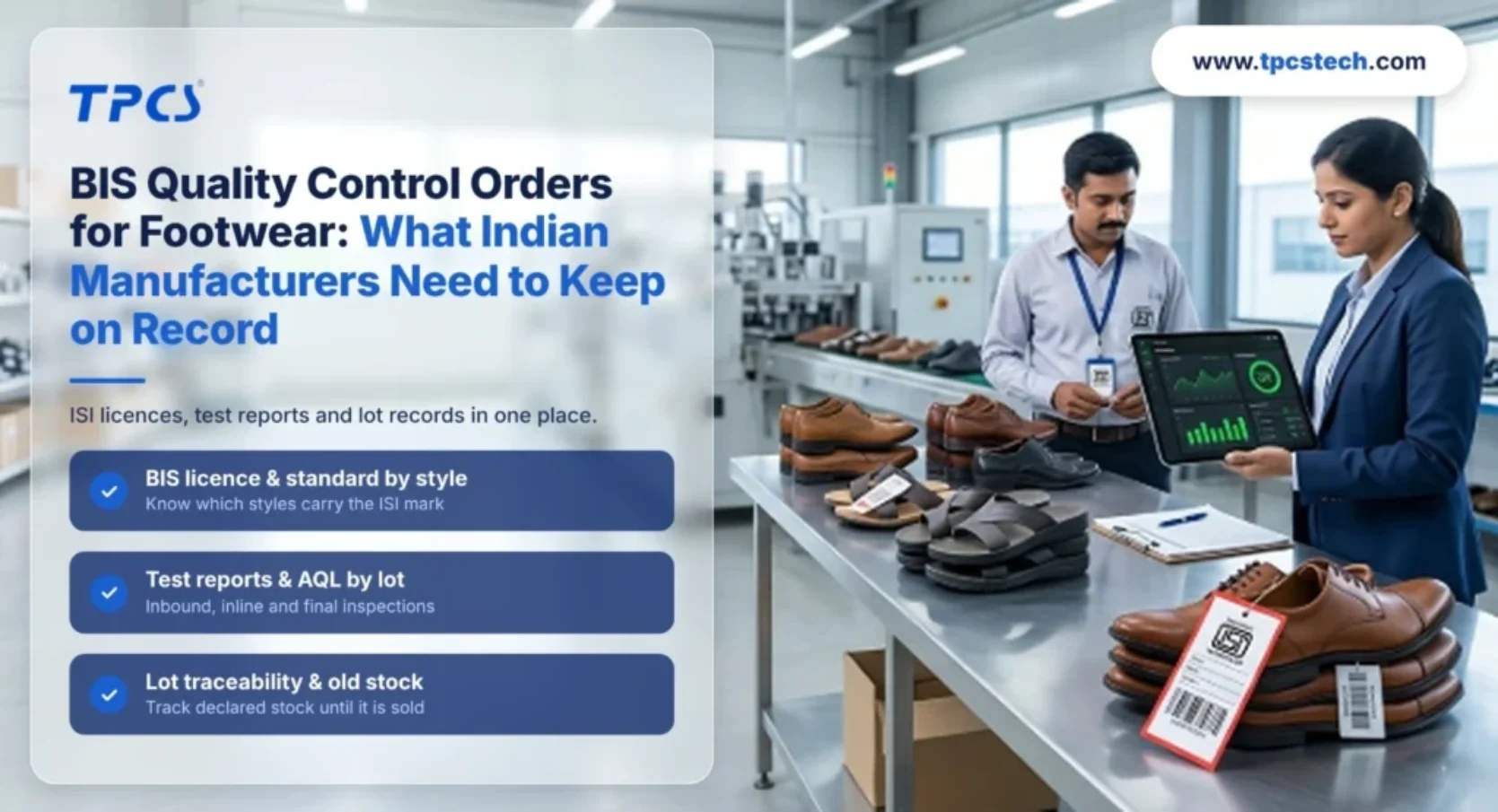
Compliance is easier to prove when quality and production records live in one place:
| Record | Why it matters | Where it should live |
|---|---|---|
| BIS licence details by product and standard | Shows which styles may carry the ISI mark | Style master linked to licence |
| Test reports by product and lot | Evidence that production meets the standard | Linked to the production lot or order |
| Inbound material inspection results | Shows control over soles, compounds and components | Inventory and QC module |
| In-process and final inspection records | Part of the quality control plan | QC module, linked to WIP |
| Batch and lot traceability | Links finished pairs to materials and production dates | Production and inventory |
| Declared old stock and its sale | Needed for the stock-clearance deadline | Inventory, by style and quantity |
How a footwear ERP helps
An ERP does not give you a BIS licence, but it makes the evidence easy to find:
Every style can carry its applicable standard and licence reference.
Test reports and certificates can be attached to lots and orders.
Inbound, inline and final inspections are recorded with dates and results.
Finished goods can be traced back to material lots and production dates.
Old declared stock can be tracked separately until it is sold or written off.
TPCS footwear ERP for Indian manufacturers includes AQL inspection and rejection tracking, QR-based production tracking and GST-compliant finance, and supports leather, EVA, PU and sports footwear.
Frequently asked questions
Is BIS certification mandatory for footwear in India?
Yes, for products covered by the footwear Quality Control Orders. Covered products must be made under a BIS licence and carry the ISI mark.
Which footwear QCO covers EVA and PVC sandals?
The order for footwear made from all rubber and all polymeric material and its components, which covers products such as PVC and EVA sandals and slippers.
What changed in the June 2026 footwear QCO amendment?
According to published summaries, the deadline to sell declared old uncertified stock moved to 31 July 2027, and a limited R&D import exemption was added. New production must already comply.
Do importers need BIS certification for footwear?
Yes. Foreign manufacturers of covered footwear need BIS certification, including factory assessment, testing and an Authorised Indian Representative.
How can ERP help with BIS compliance?
By linking standards, licences, test reports and inspection records to styles and production lots, so evidence is easy to produce during audits.
Keep your BIS evidence in one place
Book a TPCS footwear ERP demo to see test reports, inspections and lot traceability linked to your styles.
Sources
Bureau of Indian Standards, Quality Control Orders and certification schemes: bis.gov.in
Corpseed summary of the June 2026 footwear QCO amendment: corpseed.com (commercial summary; confirm against the official Gazette)
Outlook Business, on extra time for MSEs in non-leather footwear: outlookbusiness.com
TPCS Footwear ERP product page: tpcstech.com/footwear-erp, checked November 2026