
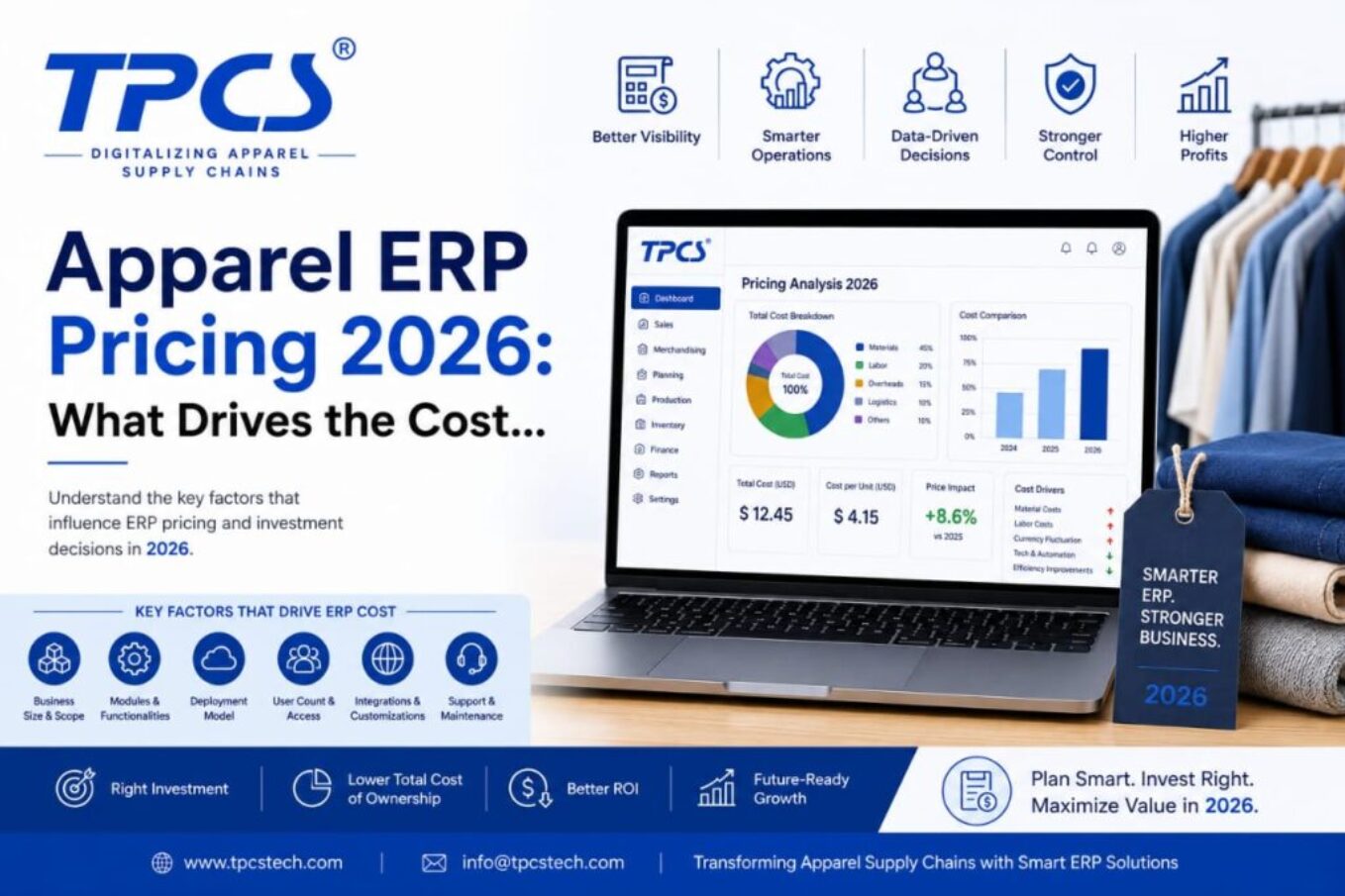
Why apparel ERP pricing is so hard to compare
Apparel ERP pricing can vary widely because vendors use different pricing models. Some charge per user, while others charge by module, transaction volume or deployment scope. Understanding these costs helps manufacturers compare ERP options more accurately.
Apparel ERP pricing is confusing because vendors price completely different things under the same word “license” — some quote per user, some per module, some per transaction volume, and enterprise platforms often don’t publish a rate at all.
That is not an accident; it lets vendors quote a low headline number while the real cost sits in modules, implementation and integrations added later.
The result is that two factories asking “what does apparel ERP cost” can get answers that differ by 10x, and both can be correct — for very different scopes of software.
Pricing models you’ll see in the market
Three pricing models dominate apparel and footwear ERP: per-user subscriptions, modular/tiered plans, and quote-based enterprise licensing.
- Per-user, per-month: Common on cloud-native platforms. Entry mid-market ERP starts around $49–$70 per user per month (MRPeasy, Microsoft Dynamics 365 Business Central), scaling with advanced modules.
- Base platform + per-user: NetSuite-style pricing commonly starts near $999/month for the core platform plus $99–$149 per full user, before retail/apparel-specific modules like Advanced Inventory or WMS are added.
- Tiered plans (Basic/Pro/Enterprise): Feature gates — customer portals, PLM integration, multi-warehouse management — trigger upgrades to the next tier rather than a straight per-user increase.
- Quote-based enterprise licensing: Larger platforms don’t publish a rate at all; pricing depends on deployment scope and is negotiated per contract.
KEY TAKEAWAYS (TL;DR)
● Apparel ERP pricing typically runs per-user, per-month, though usage-based and quote-based models are common too — entry mid-market ERP starts around $49–$70 per user per month (MRPeasy, Microsoft Dynamics 365 Business Central, 2026 listings).
● Enterprise platforms like NetSuite commonly start near $999/month for the base platform plus $99–$149 per full user, with apparel brands often investing $25K–$250K annually once modules and usage are factored in (NetSuite pricing analysis, 2026).
● Fashion PLM specifically runs $150–$600 per user per month for cloud deployments, separate from ERP (Wave PLM, 2026) — a reason apparel-native, unified platforms can undercut stacking two enterprise tools.
● The three real cost drivers are users, modules and implementation — not the sticker price on the homepage, which rarely reflects what a mid-sized factory actually pays.
● A purpose-built apparel ERP typically implements faster than a horizontal enterprise ERP bent into fashion shape, which changes the total cost of ownership even when the monthly license fee looks similar.
What changes the price: users, modules, deployment
Three variables move an apparel ERP quote more than anything on the vendor’s pricing page: how many named users need access, which modules you actually turn on, and how much implementation and integration work your rollout needs.
Users are the most linear driver — more named seats, higher recurring cost — but modules move the number more unpredictably.
A base ERP license rarely includes MRP, QC/AQL, MES-style shop-floor tracking or PLM; each is commonly a separate add-on, and fashion PLM specifically runs $150–$600 per user per month for cloud deployments on its own , which is why stacking a generic ERP with a separate PLM tool can cost more than a unified apparel platform that includes both.
Implementation is the variable buyers underestimate most.
NetSuite retail-apparel deployments commonly take 6–12 months and land first-year totals around $30K–$125K for small/mid-sized brands once implementation, integrations and modules are included — costs that never appear on a per-user rate card but dominate the real total cost of ownership.
Supplier and vendor portal access is a fourth, less obvious variable: some platforms include supplier seats free, others charge per factory account, and at scale that single line can move annual cost more than internal headcount does — worth asking about explicitly for any buying house evaluating vendor-collaboration features.
How TPCS prices, transparently
TPCS prices as one connected cloud platform — PLM, ERP, MES and WMS — rather than stacking separate licenses for product development, production and shop-floor tracking, which is where most apparel software budgets get consumed by integration work.
Because size curves, colourways and BOM structures are native to the platform rather than bolted on, deployments typically go live in 4–8 weeks, not the 6–12 months common on horizontal enterprise ERP retrofitted for fashion (TPCS, 2026).
Native integration with Tally, SAP HANA, SAP B1, Microsoft Dynamics, Power BI, Zoho, Shopify and RFID/QR scanners means you are not paying a separate middleware or integrator budget to connect TPCS to the accounting or reporting systems you already run (TPCS, 2026).
Requesting a demo or trial
Before requesting pricing, come to the conversation with three numbers: how many named users need access, which modules you actually need on day one versus later, and whether supplier/vendor accounts need portal access.
Those three questions determine most of the quote, and getting clear answers to them upfront is faster than a generic demo walkthrough.
TPCS offers scoped demos built around your BOM complexity, order volume and existing accounting stack, so the quote you receive reflects your actual deployment — not a generic per-seat rate card.
FAQ: apparel ERP pricing
How much does apparel ERP cost?
It varies widely by model. Entry mid-market cloud ERP starts around $49–$70 per user per month; enterprise platforms like NetSuite often start near $999/month plus $99–$149 per user, with total first-year cost commonly $25K–$250K once modules and implementation are included.
Why do apparel ERP quotes vary so much between vendors?
Because vendors price different scopes under the same word ‘license.’ Per-user, tiered and quote-based enterprise models measure different things, and modules like MRP, QC or PLM are frequently separate add-ons rather than included features.
Is PLM included in apparel ERP pricing, or a separate cost?
On most platforms, PLM is a separate license — cloud fashion PLM alone runs roughly $150–$600 per user per month. A unified platform that includes PLM, ERP, MES and WMS can avoid paying for two separate systems and the integration between them.
What is the biggest hidden cost in apparel ERP pricing?
Implementation and integration. NetSuite-style retail-apparel rollouts commonly run 6–12 months and add $30K–$125K in first-year cost beyond the license — costs that rarely show up on a per-user rate card.
How is TPCS priced compared to stacking multiple platforms?
TPCS prices as one connected platform covering PLM, ERP, MES and WMS, so factories are not paying separate licenses and integration costs to connect a PLM tool to an ERP tool to a shop-floor tracking tool.
Can I request a trial or demo before committing to apparel ERP pricing?
Yes — TPCS offers scoped demos based on your BOM complexity, order volume and existing accounting stack, so the pricing conversation reflects your actual deployment rather than a generic rate card.
The bottom line
The cheapest apparel ERP on paper is rarely the cheapest apparel ERP once implementation, modules and integration are counted — and 2026’s pricing landscape makes that gap wider, not narrower, as enterprise platforms bundle AI features into higher tiers.
Ask every vendor the same three questions — users, modules, deployment time — before comparing a single monthly number, and weigh a purpose-built platform’s faster go-live against a horizontal ERP’s longer, costlier rollout.
If you want a transparent quote scoped to your actual factory, that is exactly what a TPCS demo is built to produce.
Instagram:https://www.instagram.com/