
Why footwear packing is tricky
Sizes and pairs. A single order can have 8 to 15 sizes, each packed in pairs, in fixed assortments per carton.
Buyer-specific rules. Each buyer has its own box labels, barcodes, carton markings and packing instructions.
Large volumes. Export orders of tens of thousands of pairs go into hundreds of cartons.
High stakes. In the US, about 99% of footwear sold is imported, according to FDRA, so importers and retailers depend on accurate packing and labels from overseas factories to receive goods quickly.
Solid vs assorted cartons
| Carton type | What's inside | Used when | Watch out for |
|---|---|---|---|
| Solid size | All pairs one size and color | Replenishment, warehouse picking by size | Size totals must still match the order |
| Assorted (ratio) | A fixed mix of sizes, e.g. 1-2-2-2-2-1 | Store-ready assortments | Wrong ratio inside a carton |
| Solid color, assorted size | One color, several sizes | Most export orders | Mixing colorways |
| Mixed | Leftovers to complete the order | End of order | Packing list accuracy |
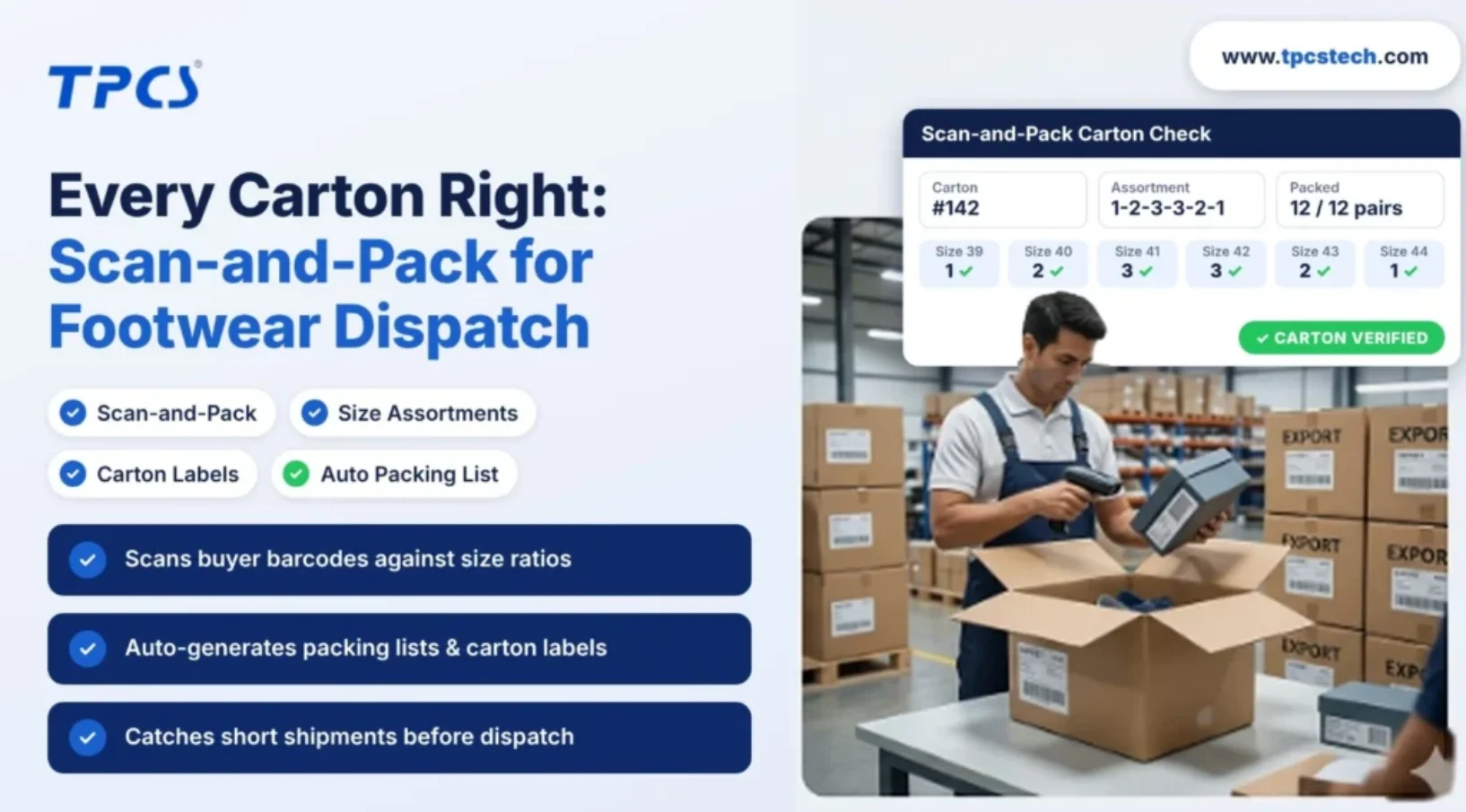
Example: a buyer asks for 12-pair cartons in a 1-2-3-3-2-1 ratio across sizes 39 to 44. An order of 6,000 pairs needs 500 cartons. Each carton must hold exactly 1 pair of 39, 2 of 40, 3 of 41, 3 of 42, 2 of 43 and 1 of 44. Scan-and-pack checks every carton against that ratio and refuses to close a carton that doesn't match.
The scan-and-pack process
1. Generate the packing plan from the order's size breakdown and the buyer's carton rules.
2. Print box and carton labels with the buyer's barcodes and carton numbers.
3. Scan each box into a carton. The system checks style, color, size and quantity against the plan.
4. Close the carton only when the scans match the planned assortment.
5. Weigh and record carton weights where buyers or freight forwarders need them.
6. Generate the packing list automatically from the scans.
7. Reconcile against the order before the truck leaves: ordered, packed, short and excess by size.
Final checks before the container is loaded
| Check | Question |
|---|---|
| Order vs packed by size | Are we short or over in any size? |
| Carton count and numbering | Does the carton count match the packing list? |
| Labels and barcodes | Do box and carton labels match the buyer's specification? |
| Final inspection status | Has the lot passed the buyer's AQL inspection? |
| Documents | Do the invoice, packing list and shipping marks agree? |
Common dispatch mistakes
Packing lists typed from memory, not generated from scans.
Box labels printed in advance for the wrong size ratio.
Odd pairs packed because pair matching was skipped at the packing table.
Short shipments discovered by the buyer, not by the factory.
How TPCS footwear ERP handles dispatch
TPCS footwear ERP with scan-and-pack includes scan-and-pack with customer barcodes and automatic dispatch and packing reports, according to the product page. Because packing shares data with orders, production and quality, the packing list reflects what was actually scanned, and short shipments by size show up before the goods leave the factory. Pair tracking and odd-pair matching in the MES add-on help keep mismatched pairs out of the box.
Frequently asked questions
What is scan-and-pack in footwear?
A packing process where each shoe box is scanned into a carton and checked against the planned size assortment, with packing lists generated from the scans.
What is an assorted size carton?
A carton holding a fixed ratio of sizes, such as 1-2-3-3-2-1, so retailers receive a ready-made size mix.
How do you avoid short shipments in footwear?
Reconcile ordered and packed quantities by size from scan data before dispatch, and fix shortages before the container is loaded.
Who decides footwear carton labels and barcodes?
The buyer. Each buyer usually specifies its own box labels, barcodes, carton markings and packing rules.
Can ERP generate footwear packing lists automatically?
Yes. Footwear ERP systems with scan-and-pack generate packing lists and carton labels directly from scanned boxes.
Pack every carton right the first time
Book a TPCS footwear ERP demo to see scan-and-pack, carton labels and size-wise dispatch reports on one of your orders.
Sources
FDRA figure on US footwear imports, via SGI News, September 2025
TPCS Footwear ERP product page (scan-and-pack, dispatch and packing reports): tpcstech.com/footwear-erp, checked November 2026
TPCS plans and pricing (pair tracking and odd-pair matching): tpcstech.com/pricing