
Where footwear defects come from
| Stage | Typical defects | Root cause to look for |
|---|---|---|
| Materials | Leather grain damage, shade variation, wrong sole hardness or color | Supplier quality, missing inbound checks |
| Cutting | Components cut across defects, wrong stretch direction | Clicker skill, poor lot grading |
| Closing | Skipped or uneven stitches, wrinkles, misaligned overlays | Machine settings, operator training |
| Lasting | Uneven toe shape, upper pulled off-centre, loose heel seat | Last condition, lasting pressure, moisture |
| Sole attaching | Sole separation, adhesive marks, gaps at the feather line | Primer, adhesive, activation temperature, pressing time |
| Finishing | Scratches, color mismatch, dirty linings | Handling, finishing materials |
| Packing | Wrong size label, odd pairs, missing tissue or tag | Pair matching, carton checks |
Sole separation and pair mismatch are among the defects buyers treat most seriously, because they lead to returns from end customers.
Inbound inspection: stop bad material at the gate
Leather: measure area against the invoice, grade by defects, group by shade and check thickness.
Soles: check size marking, color, finish and quantity per size; check hardness where specified.
Components and trims: check counts, sizes and color against the approved sample.
Adhesives: check batch and expiry.
Use a consistent sampling plan, record results against the supplier and raise rejections immediately.
Inline QC: catch defects where they start
Place quality checkpoints after the operations that create the most expensive problems:
1. After cutting: component count, defect avoidance, shade grouping per pair.
2. After closing: stitch quality, alignment, measurements.
3. After lasting: shape, symmetry, heel height and heel seat.
4. After sole attaching: bond quality, cleanliness at the feather line, spot pull tests.
5. After finishing: cosmetic checks and pair matching before packing.
Record defects by type, size and line on a tablet rather than paper, so patterns show up the same day.
Final AQL inspection
Final inspections normally follow ISO 2859-1 sampling plans. The buyer specifies an inspection level (General Level II is common) and acceptable quality limits. Many footwear buyers use AQL 0 or very low limits for critical defects, 2.5 for major defects and 4.0 for minor defects, but always follow the buyer's own standard.
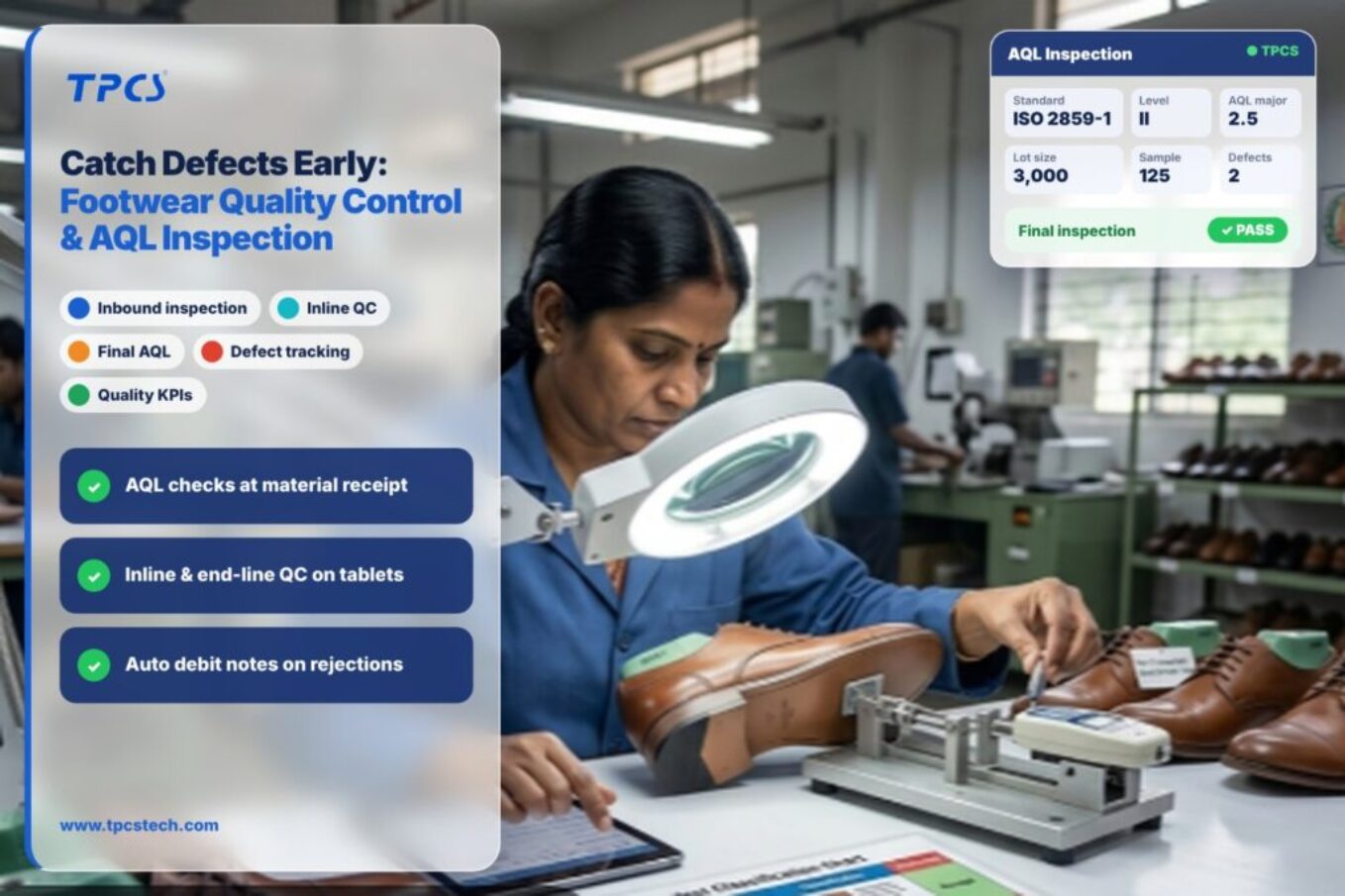
Example: a lot of 3,000 pairs at General Inspection Level II uses code letter K, which means a sample of 125 pairs. At AQL 2.5 for major defects, the lot is accepted with up to 7 major defects and rejected at 8. At AQL 4.0 for minor defects, it is accepted with up to 10 and rejected at 11. Confirm sample sizes and accept/reject numbers against the current ISO 2859-1 tables or your buyer's manual.
Physical tests buyers often ask for
Depending on the product and market, buyers may require laboratory tests such as sole bond strength, flex resistance, abrasion resistance, color fastness and restricted substances. Test methods published by organizations such as SATRA (UK) and ISO standards are widely used in footwear. Keep test reports linked to the production lot they cover.
Measuring quality: the numbers that matter
| KPI | Formula | Why it matters |
|---|---|---|
| Inline rejection rate | Rejected pairs ÷ pairs checked × 100 | Shows where defects start |
| Defects per hundred pairs | Total defects ÷ pairs checked × 100 | Counts every defect, not just rejected pairs |
| First-pass yield | Pairs passed without rework ÷ pairs produced × 100 | Hidden rework costs |
| Final inspection pass rate | Lots passed ÷ lots inspected × 100 | Shipment risk |
| Supplier rejection rate | Rejected material ÷ material received × 100 | Supplier performance |
How TPCS footwear ERP handles quality
In TPCS footwear ERP with AQL, quality data sits in the same system as production:
AQL inspection and rejection tracking at material receipt.
Inline and end-line QC on tablets, linked to bundles and job cards.
Rejected pairs and components recorded by size, line and operator.
Automatic debit notes when supplier materials are rejected.
Alpine Shoes, an Adidas supplier, reports a 20% reduction in rejections after rolling out TPCS ERP, MES and AQL across its upper and assembly lines.
Frequently asked questions
What is AQL in footwear inspection?
Acceptable Quality Limit: the maximum defect rate a buyer accepts in a lot, applied through ISO 2859-1 sampling tables to decide how many pairs to inspect and how many defects are allowed.
What are the most common defects in shoes?
Sole separation, stitching defects, lasting faults, color or shade mismatch, adhesive marks, scratches and odd or mislabeled pairs.
How many pairs are inspected in a final AQL inspection?
It depends on lot size and inspection level. For example, a 3,000-pair lot at General Level II uses a sample of 125 pairs.
What is the difference between inline and final inspection?
Inline checks happen during production to catch defects early. Final inspection checks a sample of packed pairs before shipment.
How can footwear factories reduce rejections?
Inspect materials on arrival, put inline checkpoints after cutting, closing, lasting and sole attaching, and record defects digitally so root causes are fixed quickly.
See AQL and inline QC in one system
Book a TPCS footwear ERP demo to see inbound, inline and final inspection linked to your orders and suppliers.
Sources
ISO 2859-1, Sampling procedures for inspection by attributes (International Organization for Standardization)
SATRA Technology, footwear test methods: satra.com
TPCS Footwear ERP product page (AQL and rejection tracking): tpcstech.com/footwear-erp, checked November 2026
TPCS homepage (Alpine Shoes result): tpcstech.com