
Why "we have 300 workers" is not a capacity plan
This is a composite scenario based on situations footwear factories describe to us.
A Chennai shoe exporter took two large orders for the same month because the cutting and closing sections had plenty of people. What nobody checked was the lasting line: one line with a fixed number of lasting machines and a limited set of lasts in each size. Closing produced uppers faster than lasting could consume them. Uppers piled up, and one order shipped late even though "the factory had capacity."
Find the bottleneck first
| Construction | Usual bottleneck | Capacity unit |
|---|---|---|
| Cemented leather shoes | Lasting line or sole pressing | Pairs per day per line |
| Goodyear welted or stitched | Welting or sole stitching | Pairs per day per machine |
| Direct injection (DIP) | Injection machine stations and moulds | Pairs per shift per machine |
| EVA or PU moulded | Moulding machine and mould sets per size | Pairs per cycle × cycles per shift |
| Sandals and slippers | Assembly or strap attaching | Pairs per day per line |
Cutting and closing can usually flex with overtime or jobwork. The bottleneck cannot, so everything else should be planned around it.
Calculate bottleneck capacity in pairs
Daily capacity (pairs) = stations or machines × pairs per hour per station × productive hours × efficiency
Worked example: a cemented-shoe lasting line with 6 toe-lasting stations, each able to last about 60 pairs an hour on a mature style, 8 productive hours, 75% efficiency.
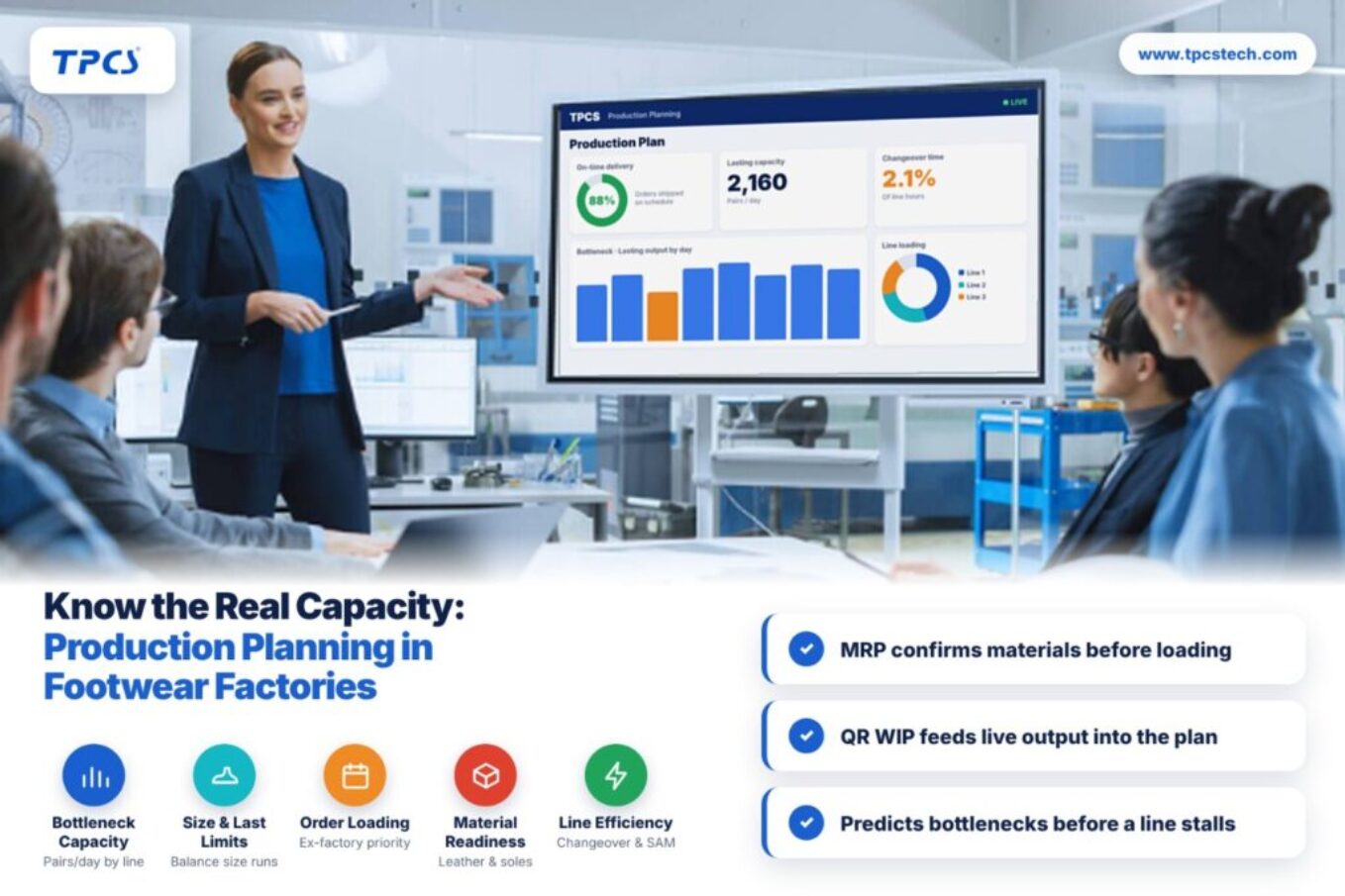
6 × 60 × 8 × 0.75 = 2,160 pairs per day on a mature style.
Two more limits matter in footwear:
Lasts in each size. If you own 60 pairs of size 42 lasts and each pair stays on the last for 4 hours to set, that size can only cycle about 120 pairs in an 8-hour shift, whatever the machine capacity.
Moulds in each size. In DIP, EVA and PU plants, the number of mould pairs per size caps output for that size.
Load orders onto lines
| Order | Style | Pairs | Construction | Ex-factory | Materials ready? | Days at bottleneck (at 2,160/day) |
|---|---|---|---|---|---|---|
| A | Derby, black | 8,000 | Cemented | 10 Dec | Yes | 3.7 |
| B | Loafer, tan | 6,500 | Cemented | 14 Dec | Soles due 2 Dec | 3.0 |
| C | Chelsea boot | 9,000 | Cemented | 18 Dec | Leather due 5 Dec | 4.2 |
Load in ex-factory order, but only start an order on the bottleneck when its materials are in the store. In this example, Order B cannot start before its soles arrive on 2 December, so planning must either hold the line for it or pull Order C forward if its leather arrives early.
Account for changeovers and learning curves
Style changeovers cost time: last changes, sole changes, machine settings. Group similar constructions and last shapes together where delivery dates allow.
New styles start slow. Plan the first days of a new style at a lower efficiency (often around half of mature efficiency) and increase it as operators learn.
Size-run sequencing matters when lasts are limited. Spread large orders across sizes so no single size's lasts become the constraint.
India-specific planning notes
Festival periods (Diwali, Eid, Pongal) reduce working days and often attendance for a week or more after.
Monsoon power cuts in some clusters affect drying and setting times.
Peak export seasons for UK and EU buyers overlap, so book jobwork capacity early.
How TPCS footwear ERP supports production planning
In TPCS footwear production planning software, planning connects to the rest of the system:
Orders carry size breakdowns and ex-factory dates from merchandising.
MRP shows material readiness for each order before it is loaded.
QR-based WIP tracking feeds actual output back into the plan.
AI scheduling predicts bottlenecks so planners can act before a line stalls.
The Enterprise plan also includes production planning on SAM/SMV with drag-and-drop line loading, according to the TPCS pricing page.
Frequently asked questions
How do you calculate production capacity in a shoe factory?
Measure the bottleneck (often lasting or sole attaching) in pairs per hour per station, multiply by stations, productive hours and efficiency, and check last and mould availability per size.
What is the bottleneck in footwear production?
In cemented shoe production it is often the lasting line or sole pressing. In injection and moulded footwear, it is usually machine stations and the number of moulds per size.
How many lasts does a shoe factory need?
Enough pairs in each size to keep the lasting line running while shoes stay on the last to set. Too few lasts in popular sizes limits output regardless of machine capacity.
Should footwear planning be done in pairs or SAM?
Both work. Pairs per day at the bottleneck is simple and intuitive; SAM or SMV-based planning handles mixed styles more precisely.
How does ERP improve footwear production planning?
It links orders, material readiness and live WIP, so plans reflect what can actually start and what is actually being produced.
Plan your lines around the real bottleneck
Book a TPCS footwear ERP demo and we'll load your current orders against lasting capacity and material readiness.
Sources
TPCS Footwear ERP product page (production module, AI scheduling): tpcstech.com/footwear-erp, checked November 2026
TPCS plans and pricing (production planning on SAM/SMV in Enterprise): tpcstech.com/pricing