
Plenty of stock, nothing to use
This is a composite scenario based on situations footwear factories describe to us.
A PU sandal maker near Bahadurgarh had a store full of soles: about 40,000 pairs on the shelves. Yet two lines stood idle for a day because there were no size 8 soles in black for a confirmed order. The shelves held size 6 and 7 in brown from an order the buyer had cut back.
The store was not short of material. It was short of the right material. That is the problem MRP exists to solve.
How footwear MRP works, step by step
1. Start from confirmed and forecast orders. Each order carries a style, colorway and size breakdown.
2. Explode the size-wise BOM. Requirement = BOM quantity per size × pairs in that size, for every component.
3. Net off what you already have. Subtract free stock in the store and quantities already on open purchase orders.
4. Apply wastage and minimum order quantities. Add a planned wastage allowance and round up to vendor pack sizes or MOQs.
5. Back-schedule from the production date. Purchase date = cutting or lasting start date minus vendor lead time minus inspection time.
6. Raise indents and purchase orders. Group requirements by vendor and send POs with size breakdowns attached.
7. Re-run when orders change. Every amendment, cancellation or size change should update requirements automatically.
A worked example: soles for one order
Order: 6,000 pairs of a women's sandal, black, sizes 36 to 41. Sole lead time: 21 days. Lasting starts on 10 December.
| Size | Pairs ordered | Free stock (pairs) | Open PO (pairs) | Net requirement | Add 2% wastage | Order qty (rounded to 50) |
|---|---|---|---|---|---|---|
| 36 | 600 | 150 | 0 | 450 | 459 | 500 |
| 37 | 1,000 | 0 | 300 | 700 | 714 | 750 |
| 38 | 1,400 | 200 | 0 | 1,200 | 1,224 | 1,250 |
| 39 | 1,400 | 0 | 0 | 1,400 | 1,428 | 1,450 |
| 40 | 1,000 | 100 | 0 | 900 | 918 | 950 |
| 41 | 600 | 0 | 0 | 600 | 612 | 650 |
| Total | 6,000 | 450 | 300 | 5,250 | 5,550 |
With a 21-day lead time and three days for inbound inspection, the sole PO must go out by 16 November. The same calculation runs for every component in the BOM: leather by area, linings, insoles, buckles, adhesives and boxes.
Lead times differ by component
| Component | Typical lead-time pattern | Planning tip |
|---|---|---|
| Finished leather | Weeks, longer for special colors or finishes | Book leather first; it sets the order's critical path |
| Moulded soles | Depends on whether moulds exist for every size | New sizes or designs need tooling time before production |
| Insoles, toe puffs, counters | Usually shorter | Group by vendor to reach MOQs |
| Trims and buckles | Short if stocked; long if custom or imported | Flag buyer-nominated trims early |
| Adhesives and chemicals | Short | Keep a reorder level rather than ordering per style |
| Packing | Short, but buyer artwork approval can delay it | Approve artwork alongside the sample |
Actual lead times vary by vendor and season. The point is to record each vendor's real lead time in the system, not a guess.
When orders change: the amendment problem
Footwear orders change often: buyers cut quantities, shift size ratios or cancel colorways. Without MRP, purchase finds out late and the factory ends up with excess soles in the wrong sizes, like the Bahadurgarh store above.
A good MRP setup does three things when an order changes:
Recalculates requirements by size immediately.
Flags purchase orders that should be reduced or cancelled before the vendor starts production.
Shows which stock is now free for other orders, so it gets used instead of written off.
Signs your factory needs proper MRP
Purchase works from WhatsApp messages and printed order sheets.
You regularly air-freight or rush-buy soles and components.
Dead stock of soles and insoles in odd sizes keeps growing.
Production planning and purchasing use different versions of the order.
How TPCS footwear ERP handles MRP
The procurement module in TPCS footwear MRP software is built around size-wise requirements:
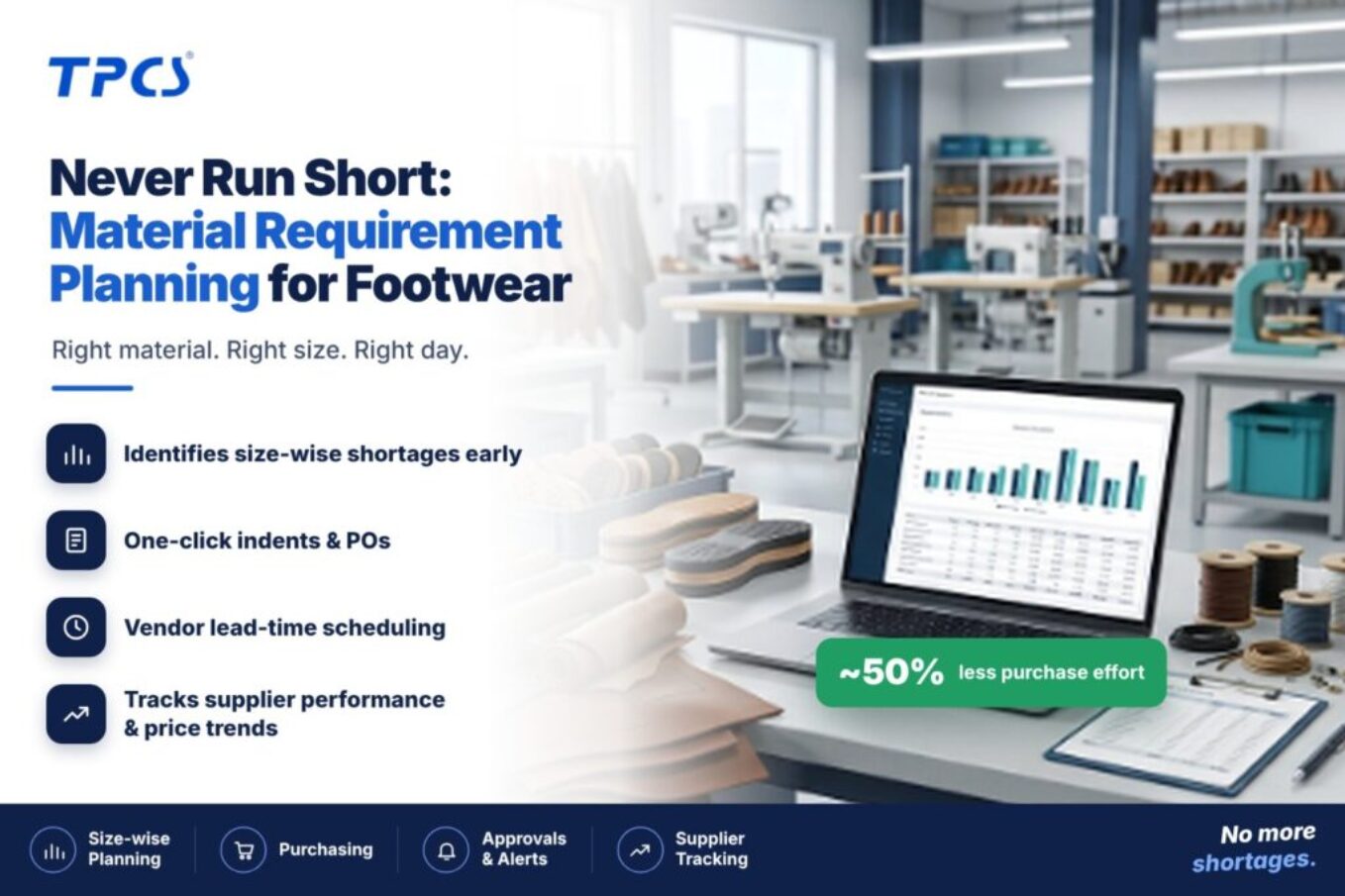
Identifies size-wise shortages early, against each order's ex-factory date.
Creates indents and purchase orders in one click, with vendor rate comparison.
Aligns purchase dates with each vendor's lead time.
Runs approval workflows and alerts.
Tracks supplier performance and price trends.
Uses AI rules to suggest releasing or cancelling purchase orders when an order is amended.
According to TPCS, this cuts purchase effort by about 50% and reduces inventory holding by about 10%. Those are the vendor's published figures; ask to see them modelled on your own orders.
Frequently asked questions
What is MRP in footwear manufacturing?
It is the process of calculating which materials and components are needed, in which sizes and quantities, and when to order them, based on orders, the size-wise BOM, stock and vendor lead times.
Why do shoe factories run short of soles even with full stores?
Because stock is held in the wrong sizes or colors. MRP that works by size and colorway prevents this by matching purchases to each order's size breakdown.
How does MRP handle order cancellations?
It recalculates requirements and flags purchase orders that can be reduced or cancelled, and frees stock for other orders.
Can MRP work in a spreadsheet?
For one or two orders, yes. With many orders, styles and sizes running at once, spreadsheets cannot keep stock, open POs and amendments in sync.
What data does footwear MRP need?
Accurate size-wise BOMs, live stock by size and color, open purchase orders, vendor lead times and production start dates.
See size-wise MRP run on your order
Book a TPCS footwear ERP demo and we'll explode one of your orders into size-wise requirements, then change the size ratio live.
Sources
TPCS Footwear ERP product page (procurement module, 50% purchase effort and 10% inventory holding claims): tpcstech.com/footwear-erp, checked November 2026