
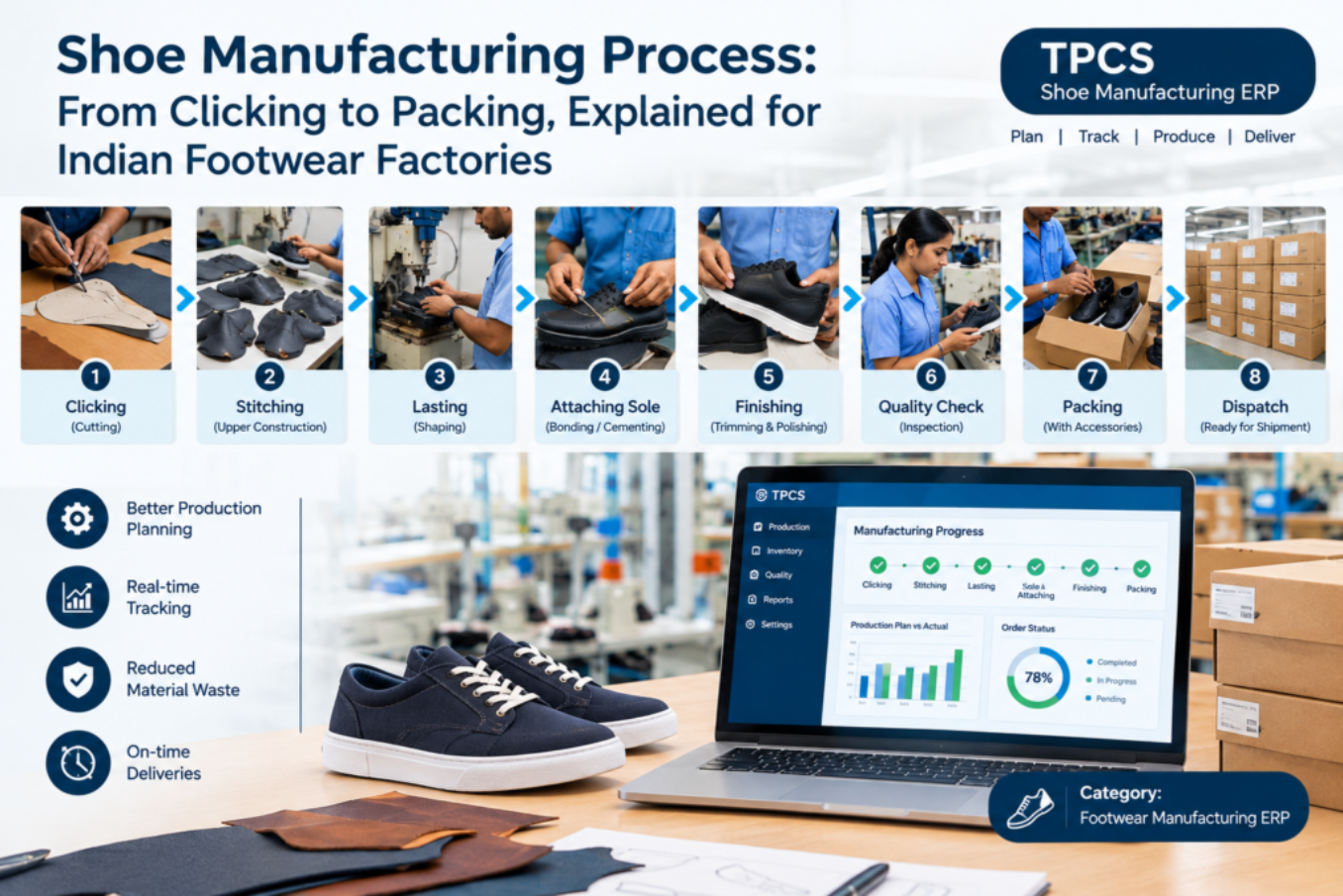
The shoe manufacturing process typically runs through design and last development, pattern making, clicking (cutting), skiving and preparation, closing (stitching the upper), lasting, sole attaching, finishing, inspection and packing. Footwear is harder to control than apparel because every order multiplies across sizes, half sizes, left and right feet, and many components, and because leather yield varies with every hide.
The left shoe and the right shoe
This is a composite scenario drawn from situations we see often in Indian factories.
Imran runs a leather footwear unit in Ambur. In June, his team was finishing a 12,000-pair order of men’s derby shoes for a German buyer. At final inspection, the buyer’s QC flagged a problem that made his stomach drop: in a sample of cartons, several pairs had a visible shade difference between the left and the right shoe.
The leather had come from two batches. In the clicking section, cut uppers from both batches had been mixed into the same bundles. Nobody noticed during closing or lasting, because each shoe looked fine on its own. It was only when two shoes sat side by side in a box that the difference showed.
Re-working those pairs cost Imran two weeks and a nervous conversation with a buyer he’d worked with for six years.
The fix wasn’t more inspectors. It was traceability: knowing which hide, which batch and which cutter produced each component, right through to the box.
The shoe manufacturing process, stage by stage
1. Design, last and pattern development
Everything starts with the last, the foot-shaped form the shoe is built around. The last decides fit. Patterns for each upper component are developed on the last, then graded across the size run, including half sizes where the buyer needs them.
2. Material planning
A single shoe can have many components: vamp, quarters, tongue, lining, counter, toe puff, insole, midsole, outsole, heel, laces, eyelets, thread and adhesives. The bill of materials has to cover each one, for each size and colour, for both feet.
3. Clicking (cutting)
Leather uppers are cut by hand knife or by press with dies. This is where most leather cost is won or lost, because every hide has natural marks, scars, thin areas and stretch variation. Skilled clickers place components to avoid defects and respect the stretch direction.
4. Skiving and preparation
Edges of leather components are thinned (skived) so they fold and stitch neatly. Components may be marked, stamped, reinforced or edge-painted at this stage.
5. Closing (upper stitching)
The prepared components are stitched together into the finished upper. Closing is labour-intensive and has many operations, which makes it a natural area for line balancing and piece-rate tracking.
6. Lasting
The upper is pulled tight over the last and fixed to the insole, usually by toe-lasting, side-lasting and heel-seat lasting machines. Lasting gives the shoe its final shape. Shoes often stay on the last for a set time so the shape sets.
7. Sole attaching
Depending on construction, soles are cemented, stitched (such as Goodyear welt or Blake), or directly injected (DIP). Each method needs different machines, process times and quality checks.
8. Finishing
De-lasting, sock insertion, cleaning, polishing, colour touch-up, lace insertion and final trimming.
9. Inspection and packing
Pair matching, size labelling, AQL inspection, tissue, box, carton and export marking.
Leather yield: the math every footwear owner should know
Leather is bought by area (square feet in India, often square decimetres in Europe). Unlike fabric, every hide is different.
Gross leather needed per pair = Net area per pair ÷ (1 − Cutting loss %)
Worked example:
- Net upper leather per pair: 1.6 sq ft
- Planned cutting loss: 20%
- Gross per pair: 1.6 ÷ 0.80 = 2.0 sq ft
- For 12,000 pairs: 24,000 sq ft
Now suppose actual cutting loss runs at 26% because of a weaker leather lot:
- Gross per pair: 1.6 ÷ 0.74 = 2.16 sq ft
- For 12,000 pairs: about 25,946 sq ft
- Extra leather: about 1,946 sq ft
- At ₹120 per sq ft, that’s roughly ₹2.3 lakh in extra leather, on a single order
That’s why clicking-room yield should be tracked lot by lot and cutter by cutter, not just checked at the end of the order.
Why footwear is harder to control than apparel
| Challenge | What it means on the floor |
|---|---|
| Size run with half sizes | One style can have 12–15 sizes, each needing its own components and dies |
| Pairs, not pieces | Left and right must match in shade, size and finish |
| Many components per shoe | Material shortage of one small component stops the pair |
| Natural material variation | Yield and shade change with every hide or lot |
| Multiple constructions | Cemented, stitched and injected soles need different routes |
| Long process chain | Clicking to packing crosses several departments, often in different buildings |
Six control points that prevent most problems
- Lot-wise leather receiving with shade grouping and area measurement.
- Shade-locked cutting: components for one pair always come from one shade group.
- Component tracking by bundle or RFID from clicking through closing and lasting.
- In-line QC after closing and after lasting, not just at final inspection.
- Pair matching check before boxing.
- AQL inspection on raw material and finished goods, with defect data linked back to the department.
Where TPCS fits
TPCS was built with footwear workflows (upper → lasting → assembly) alongside apparel. For footwear units, it covers:
- Size-run BOM and MRP for every component, both feet, every size
- Lot-wise material receiving with shade and area data
- Component tracking with QR or RFID through clicking, closing and lasting
- Department-wise WIP and output dashboards
- AQL for raw materials and finished goods
On the TPCS website, footwear customers include Alpine Shoes, which reports a 20% reduction in rejections after rolling out ERP, MES and AQL across upper and assembly lines, and Tangerine Skies, whose MES went live in four months.
How Imran’s story ended
Imran’s team now assigns every hide to a shade group at receiving, and the clicking section cuts components for a pair only from one group. Each bundle carries a QR tag through closing and lasting. In the next season, the German buyer’s inspection found no pair-shade mismatches.
Frequently asked questions
What are the main steps in the shoe manufacturing process?
Design and last development, pattern making, clicking (cutting), skiving, closing (upper stitching), lasting, sole attaching, finishing, inspection and packing.
What is clicking in shoe manufacturing?
Clicking is the cutting of upper components from leather or other materials, done by hand or with a press and cutting dies.
What is lasting in footwear production?
Lasting is pulling the stitched upper over a foot-shaped last and fixing it to the insole so the shoe takes its final shape.
How do you calculate leather requirement for shoes?
Gross leather per pair = Net area per pair ÷ (1 − cutting loss %). For example, 1.6 sq ft net at 20% loss needs 2.0 sq ft gross.
Which software is used in footwear manufacturing?
Footwear manufacturers use footwear-specific ERP and MES systems that handle size runs, pairs, components and lot-wise materials. TPCS is one such cloud platform built for Indian and global footwear units.
Track every pair, from hide to box
Book a TPCS Footwear ERP demo and see size-run BOMs, lot-wise leather control and component tracking on a real shoe style.