
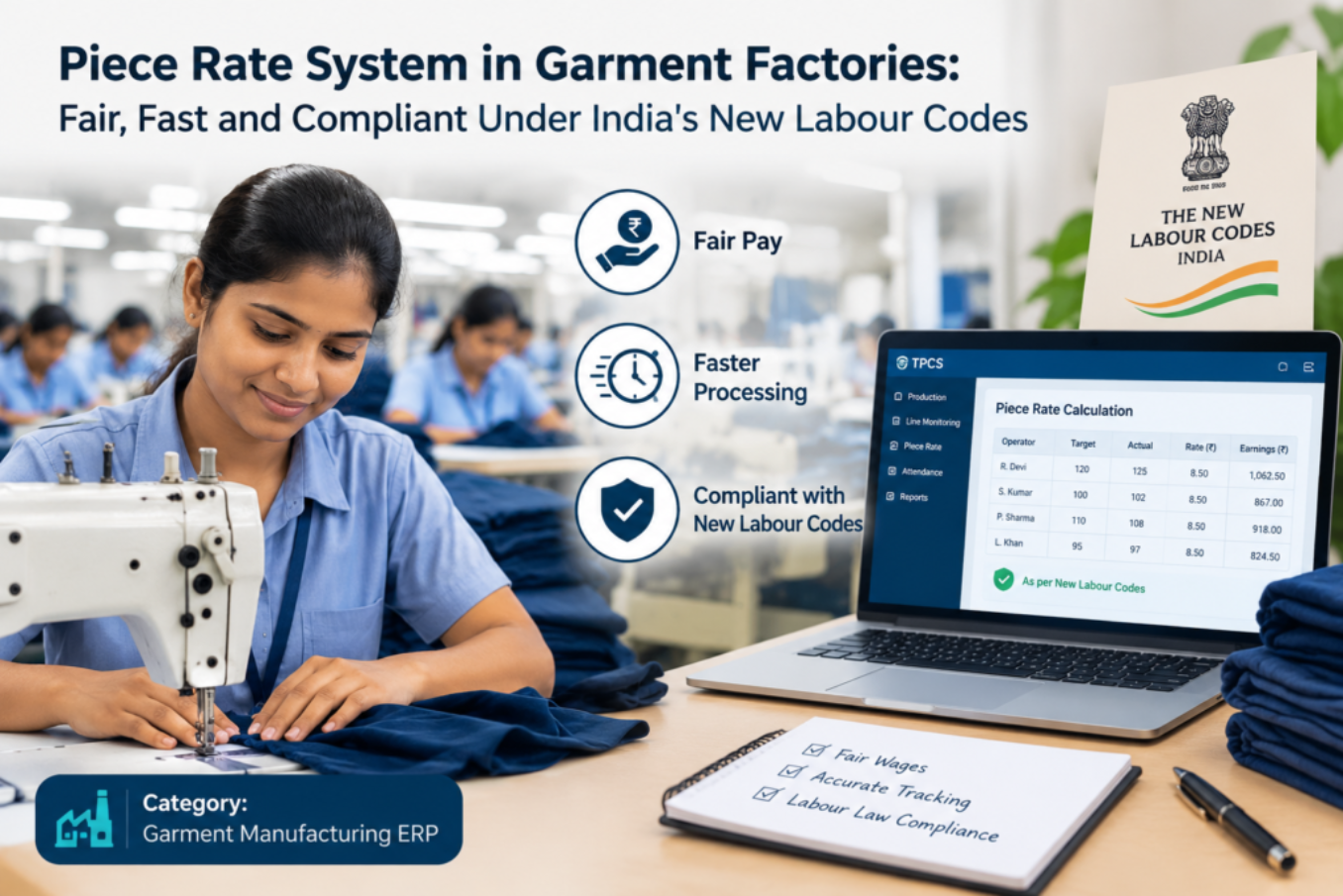
In a piece rate system, workers are paid per unit or per operation completed instead of per day. A fair piece rate is set from the operation’s SMV multiplied by a rupee rate per minute. Under India’s four Labour Codes, effective 21 November 2025, piece-rate workers are still covered by minimum wage protection, timely payment rules and double-rate overtime, so your piece counts must be accurate, traceable and reconciled against minimum wages every pay cycle.
This article explains general principles. Labour rules and minimum wages differ by state and change over time. Please confirm specifics with your labour law advisor.
Saturday, 5 pm, the accounts cabin
This is a composite scenario drawn from situations we see often in Indian factories.
Harpreet heads accounts at a 250-operator knitwear unit in Ludhiana. Every Saturday, the same scene plays out. Supervisors hand over notebooks with handwritten piece counts. Operators line up outside her cabin. Someone’s count is short by 120 pieces. Someone else was paid for a bundle that was later sent back for repair. A senior tailor says the new style’s rate is unfair compared with the last one.
It takes three people most of Saturday afternoon to close wages. And even then, Harpreet isn’t sure the numbers are right.
When the new Labour Codes came into force, the owner asked her a harder question: “Can we prove, line by line, that every worker got what they’re owed?”
Why piece rates still make sense
Piece rates reward skill and speed, and most experienced tailors prefer them. For the factory, wage cost moves with output. The problems come from three places:
- Rates set by habit, not data. Rates drift over years and nobody remembers why one operation pays more than another.
- Counting by hand. Notebooks and tally sheets are easy to miscount and impossible to audit.
- No link to quality. Pieces that fail inspection still get paid, or get paid twice after repair.
What changed with the Labour Codes
The Government of India brought the four Labour Codes (Code on Wages 2019, Industrial Relations Code 2020, Code on Social Security 2020, and the Occupational Safety, Health and Working Conditions Code 2020) into effect from 21 November 2025, consolidating 29 older central labour laws. For garment and textile units, the points that matter most for piece-rate pay are:
- Minimum wages apply to all workers. The floor applies regardless of how wages are calculated.
- Timely payment of wages is mandatory.
- Overtime requires the worker’s consent and is paid at twice the ordinary rate.
- Appointment letters are required for all workers, including piece-rate and temporary staff.
- Equal wages for fixed-term and migrant workers compared with permanent staff doing the same work.
Several states are still notifying their own rules and minimum wage rates under the Codes, so check your state’s current notifications.
How to set a fair piece rate
Piece rate per operation = Operation SMV × Rate per minute
The rate per minute is a management decision based on target earnings and your wage policy. A common approach: decide what a fully trained operator working at a target efficiency should earn for a day, then back-calculate.
Worked example:
- Operation: attach sleeve, SMV 0.50 min
- Rate per minute: ₹1.10
- Piece rate: 0.50 × 1.10 = ₹0.55 per piece
- Operator completes 900 good pieces in a day
- Earnings: 900 × 0.55 = ₹495
Because rates come from SMV, two operations that take the same standard time pay the same, which makes rates easier to explain and defend.
The minimum wage reconciliation step
If an operator’s piece earnings for a period fall below the applicable minimum wage for the time worked (because of a new style, machine breakdowns or waiting for bundles), the shortfall must be made up. Do this check every pay cycle, worker by worker:
| Step | What to check |
|---|---|
| 1 | Piece-rate earnings for the period |
| 2 | Hours actually worked (from attendance) |
| 3 | Minimum wage due for those hours in your state and skill category |
| 4 | Pay the higher of (1) and (3) |
| 5 | Add overtime separately at double the ordinary rate, with consent recorded |
Waiting time caused by the factory (no bundles, power cut, machine down) is a management problem, not the operator’s. Track it, because it shows up as minimum wage top-ups and lost output.
How to make piece counts dispute-proof
- Bundle tickets or QR codes for each operation, generated at cutting.
- Scan at each operation so the system records who did which bundle, when.
- Pay only for pieces passed at in-line or end-line QC; repairs are recorded but not paid twice.
- Show workers their own counts daily, on a display board or a printed slip, so disputes are settled the same day, not on payday.
- Lock rates per style before production starts, approved by IE and management.
A simple weekly wage routine
- Daily: operators scan bundles; supervisors resolve exceptions the same day.
- Daily: workers see their counts and earnings so far.
- Weekly: system calculates piece earnings, applies QC deductions and adds overtime.
- Weekly: minimum-wage reconciliation runs automatically against attendance.
- Weekly: approved wage sheet flows to payroll or accounts (Tally, SAP or your HRMS).
Where TPCS fits
TPCS MES connects the dots between production and pay:
- Cutting slip and job card generation creates bundle tickets with QR codes.
- Bundle and component tracking records each operator’s work by operation.
- End-line QC on tablets links passed and rejected pieces to the right bundle.
- Operator efficiency and piece rate reports calculate earnings using SMV-based rates.
- Tally and SAP integration pushes approved wage data to accounts.
The result: Saturday wage closing moves from an afternoon of arguments to a report review.
How Harpreet’s story ended
After two months on bundle scanning, Harpreet’s team closed wages in under an hour. Disputes didn’t disappear, but they dropped sharply, and they were settled with a scan history instead of a shouting match. For the first time, the owner also saw waiting-time losses by line, which became the next improvement project.
Frequently asked questions
What is a piece rate system in the garment industry?
A wage method where tailors and operators are paid for each piece or operation completed, rather than a fixed daily wage.
How is piece rate calculated?
Piece rate = Operation SMV × Rate per minute. For example, 0.50 min × ₹1.10 = ₹0.55 per piece.
Do minimum wages apply to piece-rate workers under the new Labour Codes?
Yes. The Code on Wages applies minimum wage protection to all workers. If piece earnings fall below the minimum for time worked, the employer must make up the difference. Check your state’s notified rates.
How is overtime paid to piece-rate workers?
Under the Labour Codes, overtime requires the worker’s consent and is paid at twice the ordinary rate. Your payroll policy should define how the ordinary rate is derived for piece-rate staff; confirm this with your advisor.
How can software reduce piece rate disputes?
By recording every bundle scan against an operator, linking it to QC results and showing workers their counts daily, so disagreements are resolved with data before payday.
Sources
- Ministry of Labour & Employment, Government of India: press release on implementation of the four Labour Codes (labour.gov.in), and KPMG India Flash News on the notification effective 21 November 2025, accessed October 2026.
Close wages in an hour, not an afternoon
Book a TPCS demo to see bundle scanning, piece rate calculation and wage reports working on a live shop floor.