
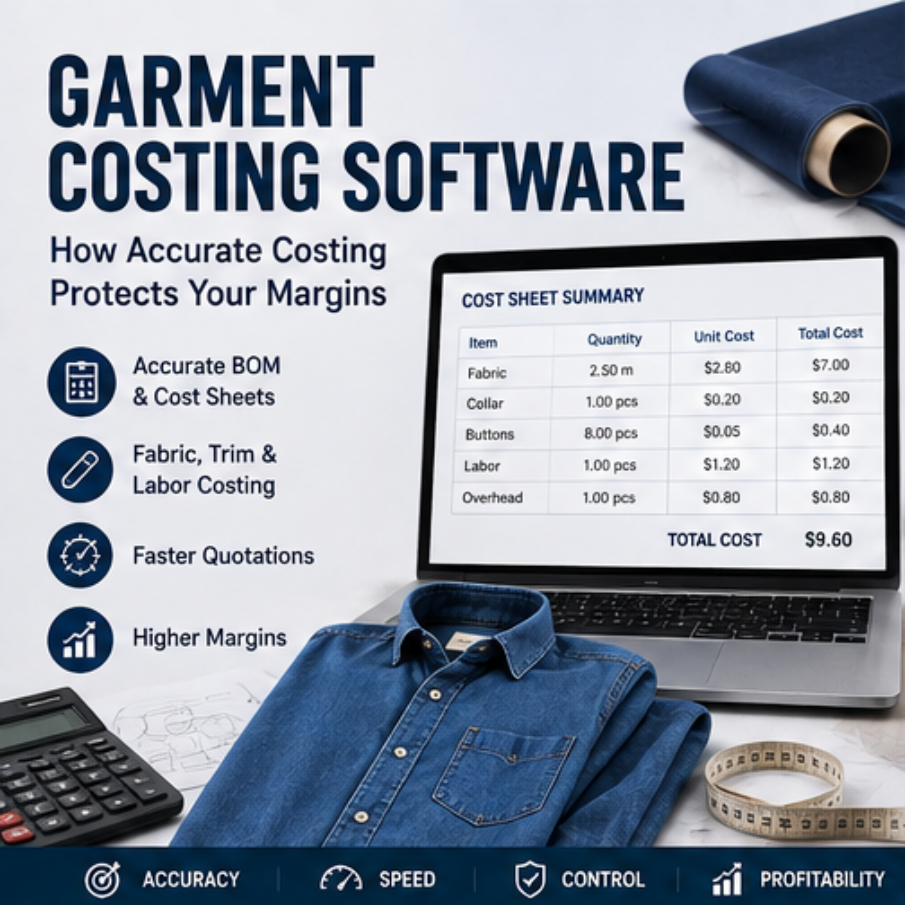
Why Manual Costing Sheets Cost You Money with Garment Costing Software
Garment costing software helps apparel manufacturers calculate product costs more accurately by managing fabric, trims, labor, BOMs, and other production expenses in a structured workflow.
Garment costing is a critical part of apparel manufacturing because the selling price needs to cover material, labor, overhead, and other production costs while leaving an acceptable margin. Many businesses begin with spreadsheets because they are flexible and inexpensive. However, as the number of styles, colorways, sizes, suppliers, and buyer revisions grows, manual costing becomes harder to control.
A spreadsheet-based process can involve repeated data entry, different versions of the same cost sheet, and calculations that depend on individual users. If a fabric price changes but an older quotation still contains the previous price, the manufacturer may quote below the intended margin. Similar problems can occur when wastage, trim prices, labor rates, or overhead assumptions are not updated consistently.
Garment costing software provides a centralized workflow for organizing these cost components. It can make costing information easier to maintain, review, revise, and use during quotation preparation.
The Anatomy of an Accurate BOM & Cost Sheet
A reliable apparel cost sheet starts with a detailed Bill of Materials (BOM). The BOM identifies the materials and components needed to make a garment, such as shell fabric, lining, trims, buttons, zippers, labels, thread, packaging, and other accessories.
An effective costing process should also account for consumption, wastage, unit prices, labor, processing, finishing, packing, overheads, and other applicable expenses. Separating these components makes it easier for costing teams to understand where the final cost comes from.
A structured BOM and cost sheet can also make revisions easier. If the buyer changes fabric, trim specifications, or order quantities, the team can review the affected cost components instead of rebuilding the entire calculation.
Fabric, Trim & Labor Costing in One System
Fabric is often one of the largest cost components in a garment, but accurate costing requires more than fabric price alone. Consumption can vary by style, size, marker efficiency, fabric width, wastage, and production method.
Trims and accessories also contribute to the final cost. Buttons, zippers, labels, elastic, embroidery, printing, packaging, and other components may need separate costing. Labor and processing costs should also be considered when calculating the expected manufacturing cost.
Managing these components in one organized workflow gives costing teams better visibility and can reduce the risk of missing smaller expenses that add up across high-volume production.
From Costing to Quotation: Speeding Up Buyer Response
Apparel buyers often request quotations with short turnaround times. During negotiation, they may ask for changes in quantity, fabric, trims, specifications, delivery schedules, or target prices. A slow costing process can delay the quotation and affect the manufacturer’s ability to respond competitively.
A centralized costing workflow can help teams revise assumptions, compare versions, and prepare updated quotations more efficiently. Faster response does not mean skipping validation; the objective is to make the underlying costing information easier to access and update.
How TPCS Handles This
TPCS is designed to support apparel and manufacturing workflows by organizing important information across business processes. For costing teams, a connected approach can help bring product, material, production, and costing information into a more structured workflow.
Manufacturers should evaluate software based on their own processes, including BOM requirements, material costing, labor calculations, quotation workflows, approvals, reporting, and integration needs. A suitable system should help reduce repetitive work while improving visibility and consistency.
FAQs
What is garment costing software?
Garment costing software is a digital solution used to calculate and manage the costs involved in producing apparel, including materials, labor, processing, and other expenses.
Why is garment costing important for manufacturers?
Accurate costing helps manufacturers prepare realistic quotations, understand expected margins, and identify cost changes before production or negotiation.
What does a garment BOM include?
A garment BOM can include fabric, trims, accessories, labels, packaging, and other components required to produce a particular style.
Can costing software help with buyer quotations?
A structured costing system can help teams revise costs and prepare quotations more efficiently, depending on the platform’s capabilities.